






 9G5H
9G5H
p53-Y220C Core Domain Covalently Bound to 2-chloro-5-cyanopyrazine Soaked at 5 mM
これはPDB形式変換不可エントリーです。
9G5H の概要
| エントリーDOI | 10.2210/pdb9g5h/pdb |
| 分子名称 | Cellular tumor antigen p53, 5-chloranylpyrazine-2-carbonitrile, 4-(2-HYDROXYETHYL)-1-PIPERAZINE ETHANESULFONIC ACID, ... (8 entities in total) |
| 機能のキーワード | covalent, snar, stabilization, cell cycle |
| 由来する生物種 | Homo sapiens (human) |
| タンパク質・核酸の鎖数 | 2 |
| 化学式量合計 | 51560.11 |
| 構造登録者 | Stahlecker, J.,Klett, T.,Stehle, T.,Boeckler, F.M. (登録日: 2024-07-17, 公開日: 2025-06-11, 最終更新日: 2025-07-16) |
| 主引用文献 | Klett, T.,Stahlecker, J.,Schwer, M.,Jaag, S.J.,Masberg, B.,Knappe, C.,Lammerhofer, M.,Stehle, T.,Boeckler, F.M. S N Ar Reactive Pyrazine Derivatives as p53-Y220C Cleft Binders with Diverse Binding Modes. Drug Des Devel Ther, 19:4727-4753, 2025 Cited by PubMed Abstract: The tumor suppressor p53 is most commonly mutated in human cancer. The structural mutant in the β-sandwich of the protein, p53-Y220C, is the ninth most common p53 mutant. The p53-Y220C mutant has a solvent-accessible hydrophobic pocket, leading to thermal destabilization of the protein. Screening of our covalent fragment library (CovLib) revealed the highly reactive pyrazine derivatives SN006 and SN007, which arylate among other cysteines in p53, the mutation-generated Cys220. Herein, comprehensive structure-activity relationship (SAR) studies of these intrinsically reactive CovLib hits were performed, aiming to identify improved stabilizers for p53-Y220C, with a more balanced reactivity profile, diverse binding modes and a better potential for chemical optimization. PubMed: 40599607DOI: 10.2147/DDDT.S513792 主引用文献が同じPDBエントリー |
| 実験手法 | X-RAY DIFFRACTION (1.65 Å) |
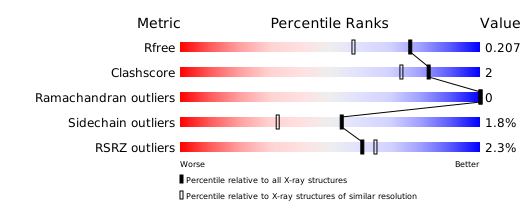
構造検証レポート
検証レポート(詳細版) をダウンロード
をダウンロード


