






9FW6
A ternary complex of plant adenosine kinase 1 from moss Physcomitrella patens (PpADK1) with adenosine and ADP
Summary for 9FW6
| Entry DOI | 10.2210/pdb9fw6/pdb |
| Related | 8RF7 8RGJ 8RPA |
| Descriptor | Adenosine kinase, ADENOSINE-5'-DIPHOSPHATE, ADENOSINE, ... (6 entities in total) |
| Functional Keywords | plant enzyme, kinase, complex, adenosine, plant protein, transferase |
| Biological source | Physcomitrium patens |
| Total number of polymer chains | 2 |
| Total formula weight | 80119.97 |
| Authors | Kopecny, D.,Vigouroux, A.,Morera, S. (deposition date: 2024-06-28, release date: 2025-04-09, Last modification date: 2025-09-03) |
| Primary citation | Kopecny, D.J.,Vigouroux, A.,Belicek, J.,Kopecna, M.,Koncitikova, R.,Friedecka, J.,Mik, V.,Supikova, K.,Humplik, J.F.,Le Berre, M.,Plancqueel, S.,Strnad, M.,von Schwartzenberg, K.,Novak, O.,Morera, S.,Kopecny, D. A monomer-dimer switch modulates the activity of plant adenosine kinase. J.Exp.Bot., 76:3457-3479, 2025 Cited by PubMed Abstract: Adenosine undergoes ATP-dependent phosphorylation catalyzed by adenosine kinase (ADK). In plants, ADK also phosphorylates cytokinin ribosides, transport forms of the hormone. Here, we investigated the substrate preferences, oligomeric states and structures of ADKs from moss (Physcomitrella patens) and maize (Zea mays) alongside metabolomic and phenotypic analyses. We showed that dexamethasone-inducible ZmADK overexpressor lines in Arabidopsis can benefit from a higher number of lateral roots and larger root areas under nitrogen starvation. We discovered that maize and moss enzymes can form dimers upon increasing protein concentration, setting them apart from the monomeric human and protozoal ADKs. Structural and kinetic analyses revealed a catalytically inactive unique dimer. Within the dimer, both active sites are mutually blocked. The activity of moss ADKs, exhibiting a higher propensity to dimerize, was tenfold lower compared to maize ADKs. Two monomeric structures in a ternary complex highlight the characteristic transition from an open to a closed state upon substrate binding. This suggests that the oligomeric state switch can modulate the activity of moss ADKs and likely other plant ADKs. Moreover, dimer association represents a novel negative feedback mechanism, helping to maintain steady levels of adenosine and AMP. PubMed: 40063605DOI: 10.1093/jxb/eraf094 PDB entries with the same primary citation |
| Experimental method | X-RAY DIFFRACTION (1.73 Å) |
Structure validation
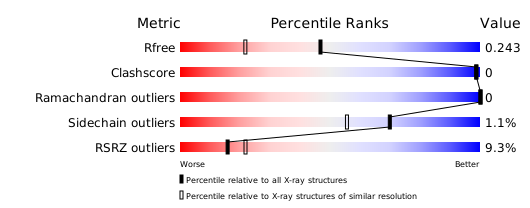
Download full validation report


