






 9FUG
9FUG9FUG の概要
| エントリーDOI | 10.2210/pdb9fug/pdb |
| 分子名称 | SNAr1.3 (K39A), DI(HYDROXYETHYL)ETHER, 2,4-dinitroiodobenzene, ... (5 entities in total) |
| 機能のキーワード | snarase, biosynthetic protein |
| 由来する生物種 | synthetic construct |
| タンパク質・核酸の鎖数 | 1 |
| 化学式量合計 | 28014.28 |
| 構造登録者 | |
| 主引用文献 | Lister, T.M.,Roberts, G.W.,Hossack, E.J.,Zhao, F.,Burke, A.J.,Johannissen, L.O.,Hardy, F.J.,Millman, A.A.V.,Leys, D.,Larrosa, I.,Green, A.P. Engineered enzymes for enantioselective nucleophilic aromatic substitutions. Nature, 639:375-381, 2025 Cited by PubMed Abstract: Nucleophilic aromatic substitutions (SAr) are among the most widely used processes in the pharmaceutical and agrochemical industries, allowing convergent assembly of complex molecules through C-C and C-X (X = O, N, S) bond formation. SAr reactions are typically carried out using forcing conditions, involving polar aprotic solvents, stoichiometric bases and elevated temperatures, which do not allow for control over reaction selectivity. Despite the importance of SAr chemistry, there are only a handful of selective catalytic methods reported that rely on small organic hydrogen-bonding or phase-transfer catalysts. Here we establish a biocatalytic approach to stereoselective SAr chemistry by uncovering promiscuous SAr activity in a designed enzyme featuring an activated arginine. This activity was optimized over successive rounds of directed evolution to afford an engineered biocatalyst, SAr1.3, that is 160-fold more efficient than the parent and promotes the coupling of electron-deficient arenes with carbon nucleophiles with near-perfect stereocontrol (>99% enantiomeric excess (e.e.)). SAr1.3 can operate at a rate of 0.15 s, perform more than 4,000 turnovers and can accept a broad range of electrophilic and nucleophilic coupling partners, including those that allow construction of challenging 1,1-diaryl quaternary stereocentres. Biochemical, structural and computational studies provide insights into the catalytic mechanism of SAr1.3, including the emergence of a halide binding pocket shaped by key catalytic residues Arg124 and Asp125. This study brings a landmark synthetic reaction into the realm of biocatalysis to provide an efficient and versatile platform for catalytic SAr chemistry. PubMed: 39814071DOI: 10.1038/s41586-025-08611-0 主引用文献が同じPDBエントリー |
| 実験手法 | X-RAY DIFFRACTION (1.71 Å) |
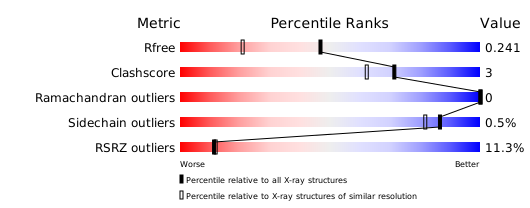
構造検証レポート
検証レポート(詳細版) をダウンロード
をダウンロード


