






9FTN
Crystal Structure of Autotaxin (ENPP2) with Type VI Inhibitor, a Novel Class of Inhibitors with Three-Point Lock Binding Mode
これはPDB形式変換不可エントリーです。
9FTN の概要
| エントリーDOI | 10.2210/pdb9ftn/pdb |
| 分子名称 | Isoform 2 of Ectonucleotide pyrophosphatase/phosphodiesterase family member 2, alpha-D-mannopyranose-(1-3)-[alpha-D-mannopyranose-(1-6)]beta-D-mannopyranose-(1-4)-2-acetamido-2-deoxy-beta-D-glucopyranose-(1-4)-2-acetamido-2-deoxy-beta-D-glucopyranose, ZINC ION, ... (8 entities in total) |
| 機能のキーワード | type vi, inhibitor, complex, ectonucleotide pyrophosphatase/phosphodiesterase 2, lysophospholipase d (lysopld), lysophosphatidic acid (lpa), hydrolase |
| 由来する生物種 | Rattus norvegicus (Norway rat) |
| タンパク質・核酸の鎖数 | 1 |
| 化学式量合計 | 95239.47 |
| 構造登録者 | |
| 主引用文献 | Desroy, N.,Borza, R.,Heiermann, J.,Triballeau, N.,Joncour, A.,Bienvenu, N.,Hengeveld, W.J.,Springer, J.,Galien, R.,Joosten, R.P.,Perrakis, A.,Heckmann, B. Design, Synthesis, and Biological Implications of Autotaxin inhibitors with a Three-Point lock binding mode. Bioorg.Med.Chem., 124:118181-118181, 2025 Cited by PubMed Abstract: Autotaxin (ATX) is a circulating enzyme that plays a major role in the production of the signaling mediator lysophosphatidic acid (LPA). A role for ATX/LPA signaling has been described in multiple disease areas, including fibrosis and cancer. ATX inhibitors are classified in five types (I-V) depending on how they target parts of the tripartite site (active site, pocket and tunnel). We set to explore a "penultimate" type of inhibitors, targeting all these three parts at once. Designing new analogs extending on an ethyl group of the type IV GLPG1690 compound, yielded potent new molecules. Co-crystal structures confirmed compounds that utilize a three-point lock binding mode. The most potent "type VI" inhibitors, 4 and 41, displayed increased inhibitory activity (∼40-fold) compared to the type IV close analog 3. Type VI inhibitors 4 and 41 showed cellular and phenotypic activity similar to type IV inhibitor GLPG1690. Identification of this new binding mode completes this combinatorial puzzle in inhibitor design and calls for further investigation to characterize potential therapeutic benefit. PubMed: 40233422DOI: 10.1016/j.bmc.2025.118181 主引用文献が同じPDBエントリー |
| 実験手法 | X-RAY DIFFRACTION (2.9 Å) |
構造検証レポート
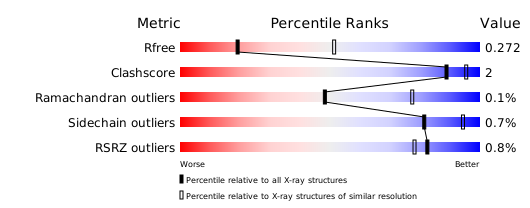
検証レポート(詳細版) をダウンロード
をダウンロード


