






 9FT7
9FT7
Structure of the human two pore domain potassium ion channel THIK-1 (K2P13.1) in a closed conformation
9FT7 の概要
| エントリーDOI | 10.2210/pdb9ft7/pdb |
| EMDBエントリー | 50741 |
| 分子名称 | Potassium channel subfamily K member 13, LINOLEIC ACID, POTASSIUM ION (3 entities in total) |
| 機能のキーワード | potassium channel, membrane protein |
| 由来する生物種 | Homo sapiens (human) |
| タンパク質・核酸の鎖数 | 2 |
| 化学式量合計 | 67915.05 |
| 構造登録者 | |
| 主引用文献 | Rodstrom, K.E.J.,Eymsh, B.,Proks, P.,Hayre, M.S.,Cordeiro, S.,Mendez-Otalvaro, E.,Madry, C.,Rowland, A.,Kopec, W.,Newstead, S.,Baukrowitz, T.,Schewe, M.,Tucker, S.J. Cryo-EM structure of the human THIK-1 K2P K + channel reveals a lower Y gate regulated by lipids and anesthetics. Nat.Struct.Mol.Biol., 32:1167-1174, 2025 Cited by PubMed Abstract: THIK-1 (KCNK13) is a halothane-inhibited and anionic-lipid-activated two-pore domain (K2P) K channel implicated in microglial activation and neuroinflammation, and a current target for the treatment of neurodegenerative disorders, for example Alzheimer's disease and amyothropic lateral sclerosis (ALS). However, compared to other K2P channels, little is known about the structural and functional properties of THIK-1. Here we present a 3.16-Å-resolution cryo-EM structure of human THIK-1 that reveals several distinct features, in particular, a tyrosine in M4 that contributes to a lower 'Y gate' that opens upon activation by physiologically relevant G-protein-coupled receptor and lipid signaling pathways. We demonstrate that linoleic acid bound within a modulatory pocket adjacent to the filter influences channel activity, and that halothane inhibition involves a binding site within the inner cavity, both resulting in conformational changes to the Y gate. Finally, the extracellular cap domain contains positively charged residues that line the ion exit pathway and contribute to the distinct biophysical properties of this channel. Overall, our results provide structural insights into THIK-1 function and identify distinct regulatory sites that expand its potential as a drug target for the modulation of microglial function. PubMed: 40011745DOI: 10.1038/s41594-025-01497-6 主引用文献が同じPDBエントリー |
| 実験手法 | ELECTRON MICROSCOPY (3.16 Å) |
構造検証レポート
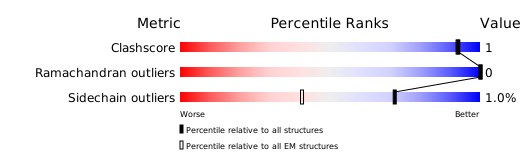
検証レポート(詳細版) をダウンロード
をダウンロード


