






 9FOI
9FOI
Structure of human KCTD1
9FOI の概要
| エントリーDOI | 10.2210/pdb9foi/pdb |
| 分子名称 | BTB/POZ domain-containing protein KCTD1, IODIDE ION, SODIUM ION, ... (6 entities in total) |
| 機能のキーワード | kctd1, potassium channel tetramerization domain containing 1, btb, ligase |
| 由来する生物種 | Homo sapiens (human) |
| タンパク質・核酸の鎖数 | 5 |
| 化学式量合計 | 148610.61 |
| 構造登録者 | Pinkas, D.M.,Richardson, W.,Bufton, J.C.,Hunt, A.E.,Manning, C.E.,Shrestha, L.,Borkowska, O.,Pike, A.C.W.,Burgess-Brown, N.A.,Bullock, A.N. (登録日: 2024-06-11, 公開日: 2025-06-25) |
| 主引用文献 | Pinkas, D.M.,Bufton, J.C.,Hunt, A.E.,Manning, C.E.,Richardson, W.,Bullock, A.N. A BTB extension and ion-binding domain contribute to the pentameric structure and TFAP2A binding of KCTD1. Structure, 32:1586-1593.e4, 2024 Cited by PubMed Abstract: KCTD family proteins typically assemble into cullin-RING E3 ligases. KCTD1 is an atypical member that functions instead as a transcriptional repressor. Mutations in KCTD1 cause developmental abnormalities and kidney fibrosis in scalp-ear-nipple syndrome. Here, we present unexpected mechanistic insights from the structure of human KCTD1. Disease-causing mutation P20S maps to an unrecognized extension of the BTB domain that contributes to both its pentameric structure and TFAP2A binding. The C-terminal domain (CTD) shares its fold and pentameric assembly with the GTP cyclohydrolase I feedback regulatory protein (GFRP) despite lacking discernible sequence similarity. Most surprisingly, the KCTD1 CTD establishes a central channel occupied by alternating sodium and iodide ions that restrict TFAP2A dissociation. The elucidation of the structure redefines the KCTD1 BTB domain fold and identifies an unexpected ion-binding site for future study of KCTD1's function in the ectoderm, neural crest, and kidney. PubMed: 39191250DOI: 10.1016/j.str.2024.07.023 主引用文献が同じPDBエントリー |
| 実験手法 | X-RAY DIFFRACTION (2.71 Å) |
構造検証レポート
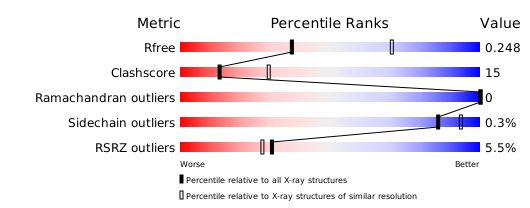
検証レポート(詳細版) をダウンロード
をダウンロード


