






Summary for 9F23
| Entry DOI | 10.2210/pdb9f23/pdb |
| Related | 9F22 9F24 |
| Descriptor | Green fluorescent protein, DARPin DP2, 2-[[(2S)-2-oxidanylpropoxy]methyl]-2-[[(2S)-2-[(2S)-2-oxidanylpropoxy]propoxy]methyl]propane-1,3-diol, ... (8 entities in total) |
| Functional Keywords | darpin, gfp, protein binding |
| Biological source | Aequorea victoria More |
| Total number of polymer chains | 4 |
| Total formula weight | 84727.75 |
| Authors | Mittl, P.R.,Hansen, S. (deposition date: 2024-04-22, release date: 2024-10-23, Last modification date: 2025-11-12) |
| Primary citation | Winkelvoss, D.,Vukovic, D.,Hanny, A.C.,Riermeier, L.,Udovcic, A.,Kolibius, J.,Honegger, A.,Mittl, P.R.E.,Michel, E.,Hansen, S.,Pluckthun, A. Molecular features defining the efficiency of bioPROTACs. Commun Biol, 8:946-946, 2025 Cited by PubMed Abstract: BioPROTACs consist of a target-binding unit and a component of the ubiquitin-proteasome system. However, the specific biophysical features influencing their effectiveness are poorly understood. We investigated the design principles defining the target-binding moiety of bioPROTACs. We used our recently developed assay for accurately measuring degradation rates, based on microinjection and live-cell microscopy, independent of other confounding factors like biosynthesis and transport. We used a very efficient UPS interaction domain from CHIP E3 ligase, and 9 different well-characterized DARPins to test degradation of the proof-of-principle target eGFP. All but two DARPins work well in this context, one sterically preventing E2 binding in the complex, the other overlapping with the target ubiquitination epitope. Affinity and thermodynamic stability of the binders had only a modest role. BioPROTACs constructed in this way were able to degrade eGFP catalytically. DARPins by themselves could also accelerate degradation of bound GFP, using other cellular E3 systems, but in a non-catalytic manner. The most important factor for efficient degradation by a bioPROTAC in trans is the correct orientation of the complex for target ubiquitination and presentation to the proteasome, still to be determined empirically. The strategies developed here show an efficient pathway to characterize and optimize such systems. PubMed: 40542219DOI: 10.1038/s42003-025-08352-w PDB entries with the same primary citation |
| Experimental method | X-RAY DIFFRACTION (1.59 Å) |
Structure validation
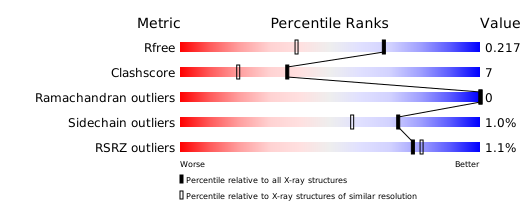
Download full validation report


