






9ERD
Human SLFN11 S753D monomer
9ERD の概要
| エントリーDOI | 10.2210/pdb9erd/pdb |
| EMDBエントリー | 19912 |
| 分子名称 | Schlafen family member 11, MAGNESIUM ION, ADENOSINE-5'-TRIPHOSPHATE, ... (4 entities in total) |
| 機能のキーワード | phosphomimetic, atp binding, monomeric, hydrolase |
| 由来する生物種 | Homo sapiens (human) |
| タンパク質・核酸の鎖数 | 1 |
| 化学式量合計 | 106857.12 |
| 構造登録者 | |
| 主引用文献 | Kugler, M.,Metzner, F.J.,Witte, G.,Hopfner, K.P.,Lammens, K. Phosphorylation-mediated conformational change regulates human SLFN11. Nat Commun, 15:10500-10500, 2024 Cited by PubMed Abstract: Human Schlafen 11 (SLFN11) is sensitizing cells to DNA damaging agents by irreversibly blocking stalled replication forks, making it a potential predictive biomarker in chemotherapy. Furthermore, SLFN11 acts as a pattern recognition receptor for single-stranded DNA (ssDNA) and functions as an antiviral restriction factor, targeting translation in a codon-usage-dependent manner through its endoribonuclease activity. However, the regulation of the various SLFN11 functions and enzymatic activities remains enigmatic. Here, we present cryo-electron microscopy (cryo-EM) structures of SLFN11 bound to tRNA-Leu and tRNA-Met that give insights into tRNA binding and cleavage, as well as its regulation by phosphorylation at S219 and T230. SLFN11 phosphomimetic mutant S753D adopts a monomeric conformation, shows ATP binding, but loses its ability to bind ssDNA and shows reduced ribonuclease activity. Thus, the phosphorylation site S753 serves as a conformational switch, regulating SLFN11 dimerization, as well as ATP and ssDNA binding, while S219 and T230 regulate tRNA recognition and nuclease activity. PubMed: 39627193DOI: 10.1038/s41467-024-54833-7 主引用文献が同じPDBエントリー |
| 実験手法 | ELECTRON MICROSCOPY (3.72 Å) |
構造検証レポート
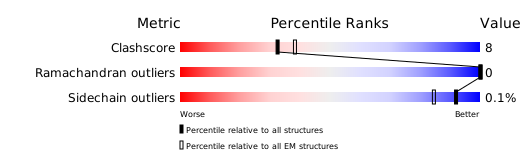
検証レポート(詳細版) をダウンロード
をダウンロード


