






 9EJA
9EJA
Human FANCJ helicase bound to a fork DNA in the closed state
9EJA の概要
| エントリーDOI | 10.2210/pdb9eja/pdb |
| EMDBエントリー | 48098 |
| 分子名称 | Fanconi anemia group J protein, DNA (5'-D(P*GP*AP*AP*AP*AP*CP*CP*CP*T)-3'), PHOSPHOTHIOPHOSPHORIC ACID-ADENYLATE ESTER, ... (5 entities in total) |
| 機能のキーワード | helicase, dna, isomerase-dna complex, isomerase/dna |
| 由来する生物種 | Homo sapiens (human) 詳細 |
| タンパク質・核酸の鎖数 | 2 |
| 化学式量合計 | 158269.88 |
| 構造登録者 | |
| 主引用文献 | You, Q.,Kakusho, N.,Sasanuma, H.,Masai, H.,Li, H. Cryo-EM structures of human FANCJ reveal the mechanism of G-quadruplex unwinding and disease-associated mutations. Nat Commun, 2026 Cited by PubMed Abstract: Guanine-rich nucleic acid sequences can fold into G-quadruplex (G4) structures that regulate DNA replication, transcription, and translation. Fanconi anemia group J helicase (FANCJ) resolves G4 structures at stalled replication forks. Despite its central role in genome maintenance, the molecular basis of G4 recognition and unwinding by FANCJ has remained unclear. Here, we report cryo-EM structures of human FANCJ bound to a G4-containing DNA substrate and ATPγS. The structures reveal direct engagement of the G4 by the Fe-S domain. Structure-guided mutagenesis demonstrates that this interface is essential for G4 binding and unwinding. The structures further capture open and closed conformational states linked to ATP hydrolysis, providing a mechanism for directional translocation along 5' ssDNA and progressive G4 unwinding. Together, these findings establish the structural basis of G4 recognition by FANCJ and provide mechanistic insights into how disease-associated mutations linked to Fanconi anemia and breast cancer impair helicase function. PubMed: 42457705DOI: 10.1038/s41467-026-75715-0 主引用文献が同じPDBエントリー |
| 実験手法 | ELECTRON MICROSCOPY (3.3 Å) |
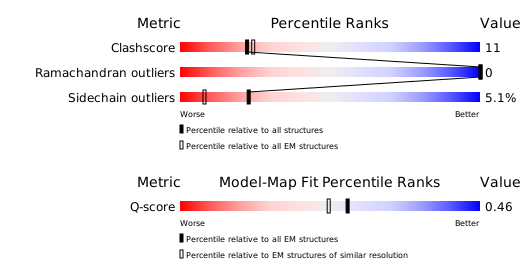
構造検証レポート
検証レポート(詳細版) をダウンロード
をダウンロード


