






9EIU
Crystal structure of the human Cavin1 HR1 TS/DD mutant domain bound to nanobody B7
9EIU の概要
| エントリーDOI | 10.2210/pdb9eiu/pdb |
| 分子名称 | Caveolae-associated protein 1, Nanobody B7 (2 entities in total) |
| 機能のキーワード | caveolae, cavin1, nanobody, protein transport |
| 由来する生物種 | Homo sapiens (human) 詳細 |
| タンパク質・核酸の鎖数 | 2 |
| 化学式量合計 | 26282.65 |
| 構造登録者 | |
| 主引用文献 | Gao, Y.,Tillu, V.A.,Wu, Y.,Rae, J.,Hall, T.E.,Chen, K.E.,Weeratunga, S.,Guo, Q.,Livingstone, E.,Tham, W.H.,Parton, R.G.,Collins, B.M. Nanobodies against Cavin1 reveal structural flexibility and regulated interactions of its N-terminal coiled-coil domain. J.Cell.Sci., 138:-, 2025 Cited by PubMed Abstract: Caveolae are abundant plasma membrane structures that regulate signalling, membrane homeostasis and mechanoprotection. Their formation is driven by caveolins and cavins and their coordinated interactions with lipids. Here, we developed nanobodies against the trimeric HR1 coiled-coil domain of Cavin1. We identified specific nanobodies that do not perturb Cavin1 membrane binding and localise to caveolae when expressed in cells. The crystal structure of a nanobody-Cavin 1 HR1 complex reveals a symmetric 3:3 architecture as validated by mutagenesis. In this structure, the C-terminal half of the HR1 domain is disordered, suggesting that the nanobody stabilises an open conformation of Cavin1, which has previously been identified as important for membrane interactions. A phosphomimic mutation in a threonine-serine pair proximal to this region reveals selective regulation of Cavin2 and Cavin3 association. These studies provide new insights into cavin domains required for assembly of multiprotein caveolar assemblies and describe new nanobody tools for structural and functional studies of caveolae. PubMed: 40260863DOI: 10.1242/jcs.263756 主引用文献が同じPDBエントリー |
| 実験手法 | X-RAY DIFFRACTION (4 Å) |
構造検証レポート
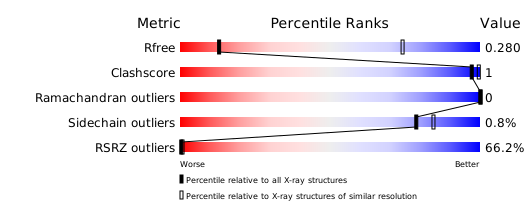
検証レポート(詳細版) をダウンロード
をダウンロード


