






 9EGE
9EGE
BSEP Apo Structure in GDN
9EGE の概要
| エントリーDOI | 10.2210/pdb9ege/pdb |
| EMDBエントリー | 47987 |
| 分子名称 | Bile salt export pump (1 entity in total) |
| 機能のキーワード | bsep, abcb11, membrane protein |
| 由来する生物種 | Homo sapiens (human) |
| タンパク質・核酸の鎖数 | 1 |
| 化学式量合計 | 146557.39 |
| 構造登録者 | |
| 主引用文献 | Gruget, C.,Reddy, B.G.,Moore, J.M. A structural and mechanistic model for BSEP dysfunction in PFIC2 cholestatic disease. Commun Biol, 8:531-531, 2025 Cited by PubMed Abstract: BSEP (ABCB11) transports bile salts across the canalicular membrane of hepatocytes, where they are incorporated into bile. Biallelic mutations in BSEP can cause Progressive Familial Intrahepatic Cholestasis Type 2 (PFIC2), a rare pediatric disease characterized by hepatic bile acid accumulation leading to hepatotoxicity and, ultimately, liver failure. The most frequently occurring PFIC2 disease-causing mutations are missense mutations, which often display a phenotype with decreased protein expression and impaired maturation and trafficking to the canalicular membrane. To characterize the mutational effects on protein thermodynamic stability, we carried out biophysical characterization of 13 distinct PFIC2-associated variants using in-cell thermal shift (CETSA) measurements. These experiments reveal a cluster of residues localized to the NBD2-ICL2 interface, which exhibit severe destabilization relative to wild-type BSEP. A high-resolution (2.8 Å) cryo-EM structure provides a framework for rationalizing the CETSA results, revealing a novel, NBD2-localized mechanism through which the most severe missense patient mutations drive cholestatic disease. These findings suggest potential strategies for identifying mechanism-based small molecule correctors to address BSEP trafficking defects and advance novel therapies for PFIC2 and other cholestatic diseases. PubMed: 40195555DOI: 10.1038/s42003-025-07908-0 主引用文献が同じPDBエントリー |
| 実験手法 | ELECTRON MICROSCOPY (2.8 Å) |
構造検証レポート
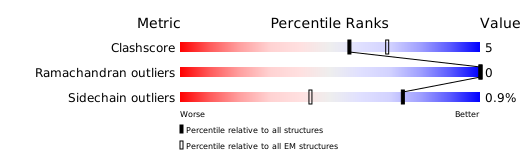
検証レポート(詳細版) をダウンロード
をダウンロード


