






 9EFB
9EFB
Chemical inhibition of the N-acetyltaurine amidohydrolase PTER reduces food intake and obesity
9EFB の概要
| エントリーDOI | 10.2210/pdb9efb/pdb |
| 分子名称 | Phosphotriesterase-related protein, 2-AMINOETHANESULFONIC ACID, ACETATE ION, ... (5 entities in total) |
| 機能のキーワード | n-acetyltaurine amidohydrolase, hydrolase |
| 由来する生物種 | Amphimedon queenslandica |
| タンパク質・核酸の鎖数 | 2 |
| 化学式量合計 | 78921.81 |
| 構造登録者 | |
| 主引用文献 | Fu, S.,Wang, L.,Li, V.L.,Lyu, X.,Wei, W.,Shi, X.,Deng, S.,Barber, J.L.,Tahir, U.A.,Adams, C.,Carson, A.,Hidalgo, B.,Raffield, L.M.,Wilson, J.G.,Razumkov, H.,Xiao, S.,Spaas, J.,Fernandez, D.,Zhang, T.,Gerszten, R.E.,Benson, M.D.,Gray, N.S.,Hinshaw, S.M.,Long, J.Z. A small molecule PTER-selective inhibitor reduces food intake and body weight. Biorxiv, 2026 Cited by PubMed Abstract: PTER (phosphotriesterase-related) is an amidohydrolase that mediates catabolism of the anorexigenic taurine metabolite N-acetyltaurine. However, the structural basis of PTER ligand binding and catalysis remain unknown, limiting our ability to harness this pathway therapeutically. Here we solve crystal structures of a eukaryotic PTER in apo and product-bound forms. These structures uncover an unexpected pocket homology between PTER and histone deacetylase (HDAC) enzymes. We exploit this similarity to engineer a first-in-class substrate-competitive PTER inhibitor called PTERi with nanomolar potency and >100-fold selectivity for PTER over HDACs in vitro. Administration of PTERi to diet-induced obese mice reduces feeding, enhances GLP1-RA (glucagon like peptide 1 receptor agonist)-induced weight loss, and prevents weight regain after GLP1-RA discontinuation. The structure of PTER connects histone and metabolite deacetylation into a parallel conceptual framework and enables proof-of-concept data for pharmacological inhibition of PTER in obesity. PubMed: 41659642DOI: 10.64898/2026.01.26.701829 主引用文献が同じPDBエントリー |
| 実験手法 | X-RAY DIFFRACTION (2.4 Å) |
構造検証レポート
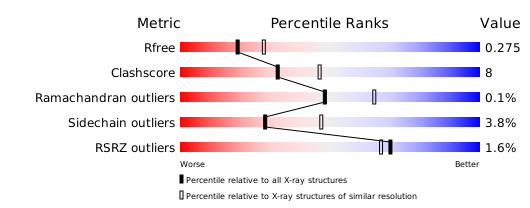
検証レポート(詳細版) をダウンロード
をダウンロード


