






9ECQ
NMR solution structure of tRNA-Arg-UCU-4-1 anticodon stem loop with no chemical modifications
9ECQ の概要
| エントリーDOI | 10.2210/pdb9ecq/pdb |
| NMR情報 | BMRB: 31216 |
| 分子名称 | Neuronally expressed tRNA-Arg-UCU-4-1 anticodon stem-loop (1 entity in total) |
| 機能のキーワード | trna, anticodon, asl, anticodon stem-loop, ucu, ucu-4-1, rna |
| 由来する生物種 | Homo sapiens |
| タンパク質・核酸の鎖数 | 1 |
| 化学式量合計 | 5364.22 |
| 構造登録者 | Berger, K.D.,Puthenpeedikakkal, A.M.K.,Matthews, D.H.,Fu, D. (登録日: 2024-11-15, 公開日: 2025-04-16, 最終更新日: 2025-06-25) |
| 主引用文献 | Berger, K.D.,Puthenpeedikakkal, A.M.K.,Mathews, D.H.,Fu, D. Structural Impact of 3-methylcytosine Modification on the Anticodon Stem-loop of a Neuronally-enriched Arginine tRNA. J.Mol.Biol., 437:169096-169096, 2025 Cited by PubMed Abstract: All tRNAs undergo a series of chemical modifications to fold and function correctly. In mammals, the C32 nucleotide in the anticodon loop of tRNA-Arg-CCU and UCU is methylated to form 3-methylcytosine (m3C). Deficiency of m3C in arginine tRNAs has been linked to human neurodevelopmental disorders, indicating a critical biological role for m3C modification. However, the structural repercussions of m3C modification are not well understood. Here, we examine the structural effects of m3C32 modification on the anticodon stem loop (ASL) of human tRNA-Arg-UCU-4-1, a unique tRNA with enriched expression in the central nervous system. Optical melting experiments demonstrate that m3C modification can locally disrupt nearby base pairing within the ASL while simultaneously stabilizing the ASL electrostatically, resulting in little net change thermodynamically. The isoenergetic nature of the C32-A38 pair versus the m3C32-A38 pair may help discriminate against structures not adopting canonical C32-A38 pairings, as most other m3C pairings are unfavorable. Furthermore, multidimensional NMR reveals that after m3C modification there are changes in hairpin loop structure and dynamics, the structure of A37, and the neighboring A31-U39 base pair. However, these structural changes after modification are made while maintaining the shape of the C32-A38 pairing, which is essential for efficient tRNA function in translation. These findings suggest that m3C32 modification could alter interactions of tRNA-Arg isodecoders with one or more binding partners while simultaneously maintaining the tRNA's ability to function in translation. PubMed: 40158946DOI: 10.1016/j.jmb.2025.169096 主引用文献が同じPDBエントリー |
| 実験手法 | SOLUTION NMR |
構造検証レポート
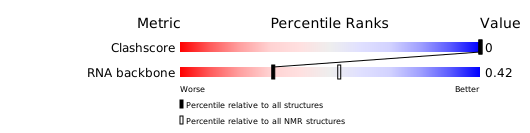
検証レポート(詳細版) をダウンロード
をダウンロード


