






 9ECM
9ECM
Structure of the human integrin alphaX transmembrane domain
9ECM の概要
| エントリーDOI | 10.2210/pdb9ecm/pdb |
| NMR情報 | BMRB: 31215 |
| 分子名称 | Integrin alpha-X (1 entity in total) |
| 機能のキーワード | integrin, cell adhesion, receptor |
| 由来する生物種 | Homo sapiens (human) |
| タンパク質・核酸の鎖数 | 1 |
| 化学式量合計 | 4640.58 |
| 構造登録者 | |
| 主引用文献 | Vu, H.N.,Lee, M.,Situ, A.J.,An, W.,Ley, K.,Kim, C.,Ulmer, T.S. Functional unfolding of the integrin alpha X transmembrane helix. Proc.Natl.Acad.Sci.USA, 122:e2507966122-e2507966122, 2025 Cited by PubMed Abstract: In biological membranes, proteins face a fundamentally different environment than in water. To avoid untenable lipid contacts with polar backbone atoms, they use the continuous hydrogen bonding achieved by α-helices or β-barrels to traverse membranes. Here, we show that integrin αX, and by homology αM, undermine this paradigm by partially unfolding the N-terminal third of their transmembrane (TM) helix. Unfolding results in a dynamic, frayed helix that weakens the association with its partnering β2 subunit to lower the activation threshold of integrin αXβ2-mediated cell adhesion. The extent of unfolding depends on membrane geometry, thereby establishing a mechanism for sensing membrane properties. The combination of adhesive control with sensory capacity in integrin αXβ2 and αMβ2 may achieve membrane localization-dependent receptor activation in leukocyte phagocytosis. The unfolding of the αX TM helix arises from a high number of α-helix-destabilizing residues that TM helices in general approach but do not exceed. Accordingly, backbone dynamics of TM helices may disrupt hydrogen bonds, modulate protein function, and optimize TM helix rigidity. PubMed: 40956891DOI: 10.1073/pnas.2507966122 主引用文献が同じPDBエントリー |
| 実験手法 | SOLUTION NMR |
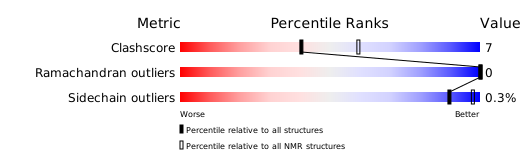
構造検証レポート
検証レポート(詳細版) をダウンロード
をダウンロード


