






9E7J
Cu-bound tetrameric copper storage protein 1 with anti-rhodopsin 1D4 epitope
9E7J の概要
| エントリーDOI | 10.2210/pdb9e7j/pdb |
| EMDBエントリー | 47678 |
| 分子名称 | Four-helix bundle copper-binding protein (1 entity in total) |
| 機能のキーワード | tetrameric copper storage protein 1, metal binding protein |
| 由来する生物種 | Methylosinus trichosporium OB3b |
| タンパク質・核酸の鎖数 | 4 |
| 化学式量合計 | 45284.54 |
| 構造登録者 | |
| 主引用文献 | Yao, W.,Oken, A.C.,Farrens, D.L. A novel "bio-tag" for cryo-EM studies based on the small, electron-dense protein Csp1. Biophys.J., 124:1414-1423, 2025 Cited by PubMed Abstract: Small proteins can be challenging to study by single-particle cryogenic electron microscopy (cryo-EM) techniques because they have low signal-to-noise ratios, making them difficult to identify and analyze. Here we investigated the use of Csp1, a small (∼50 kDa) tetrameric metal-binding protein, to act as a "bio-tag" to help overcome this problem. We find Csp1 is compact, stable, and exhibits enhanced electron scattering and excellent particle contrast in cryo-EM micrographs. As a result, we could determine the structure of Csp1 to 2.98-Å resolution using standard cryo-EM approaches. We also tested if Csp1 could be used as a tag or fiducial to help determine the structure of a protein bound to it. Specifically, we analyzed an epitope-tagged Csp1 bound to a ∼40 kDa Fab fragment from the antibody 1D4. Data from these complexes yielded medium-resolution structures of the complex (5.70 Å) and the bound 1D4 Fab (5.40 Å). These results suggest that, with further optimization, electron-rich Csp1 is a promising bio-tag for use in cryo-EM studies. PubMed: 40620219DOI: 10.1016/j.bpj.2025.03.018 主引用文献が同じPDBエントリー |
| 実験手法 | ELECTRON MICROSCOPY (2.98 Å) |
構造検証レポート
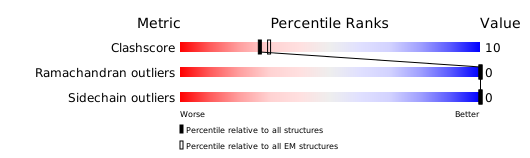
検証レポート(詳細版) をダウンロード
をダウンロード


