






 9E4E
9E4E
Human ASIC1a at pH 6.5 with linear transmembrane domain
9E4E の概要
| エントリーDOI | 10.2210/pdb9e4e/pdb |
| EMDBエントリー | 47507 |
| 分子名称 | Acid-sensing ion channel 1 (1 entity in total) |
| 機能のキーワード | ion channel, trimer, membrane protein |
| 由来する生物種 | Homo sapiens (human) |
| タンパク質・核酸の鎖数 | 3 |
| 化学式量合計 | 180757.88 |
| 構造登録者 | |
| 主引用文献 | Cahill, J.,Hartfield, K.A.,Heusser, S.A.,Ritter, N.,Poulsen, M.H.,Yoshioka, C.,Pless, S.A.,Baconguis, I. Conformational plasticity of human acid-sensing ion channel 1a. Nat.Struct.Mol.Biol., 2026 Cited by PubMed Abstract: Acid-sensing ion channels (ASICs) are typically activated by acidic environments and contribute to nociception and synaptic plasticity. ASIC1a is the most abundant subunit in the central nervous system and forms homomeric channels permeable to Na and Ca, making it a compelling therapeutic target for acidotic pathologies including stroke and traumatic brain injury. However, a complete conformational library of human ASIC1a has yet to be described. Here we show that human ASIC1a adopts six major conformations, resolved by cryo-electron microscopy across a pH range between 8.5 and 5.7 and in the presence of a toxin agonist and a gating-modifying amino acid substitution. These major conformations establish linear transmembrane helices to be associated with an open state, delineate mechanistic differences between proton and toxin activation and demonstrate that desensitization involves unexpected conformational diversity in the transmembrane domain. Together, they provide a three-dimensional framework to integrate previous structure-function studies on ASIC. PubMed: 42463865DOI: 10.1038/s41594-026-01845-0 主引用文献が同じPDBエントリー |
| 実験手法 | ELECTRON MICROSCOPY (3.16 Å) |
構造検証レポート
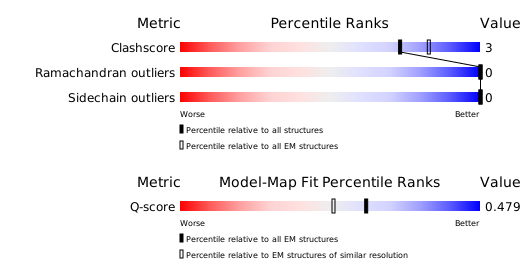
検証レポート(詳細版) をダウンロード
をダウンロード


