






 9DZE
9DZE
Computationally Designed Bifaceted Protein Nanomaterial pD5-14
9DZE の概要
| エントリーDOI | 10.2210/pdb9dze/pdb |
| EMDBエントリー | 47327 |
| 分子名称 | pD5-14 A component, pD5-14 B component, pD5-14 C component, ... (4 entities in total) |
| 機能のキーワード | nanomaterial, 4 component, bifaceted, penton, de novo protein |
| 由来する生物種 | synthetic construct 詳細 |
| タンパク質・核酸の鎖数 | 30 |
| 化学式量合計 | 1257930.97 |
| 構造登録者 | |
| 主引用文献 | Rankovic, S.,Carr, K.D.,Decarreau, J.,Skotheim, R.,Kibler, R.D.,Ols, S.,Lee, S.,Chun, J.,Tooley, M.,Dauparas, J.,Eisenach, H.E.,Glogl, M.,Weidle, C.,Borst, A.J.,Baker, D.,King, N.P. Computational design of bifaceted protein nanomaterials with tailorable properties. Biorxiv, 2024 Cited by PubMed Abstract: Recent advances in computational methods have led to considerable progress in the design of self-assembling protein nanoparticles. However, nearly all nanoparticles designed to date exhibit strict point group symmetry, with each subunit occupying an identical, symmetrically related environment. This limits the structural diversity that can be achieved and precludes anisotropic functionalization. Here, we describe a general computational strategy for designing multi-component bifaceted protein nanomaterials with two distinctly addressable sides. The method centers on docking pseudosymmetric heterooligomeric building blocks in architectures with dihedral symmetry and designing an asymmetric protein-protein interface between them. We used this approach to obtain an initial 30-subunit assembly with pseudo-D5 symmetry, and then generated an additional 15 variants in which we controllably altered the size and morphology of the bifaceted nanoparticles by designing extensions to one of the subunits. Functionalization of the two distinct faces of the nanoparticles with protein minibinders enabled specific colocalization of two populations of polystyrene microparticles coated with target protein receptors. The ability to accurately design anisotropic protein nanomaterials with precisely tunable structures and functions could be broadly useful in applications that require colocalizing two or more distinct target moieties. PubMed: 39484564DOI: 10.1101/2024.10.18.619149 主引用文献が同じPDBエントリー |
| 実験手法 | ELECTRON MICROSCOPY (4.3 Å) |
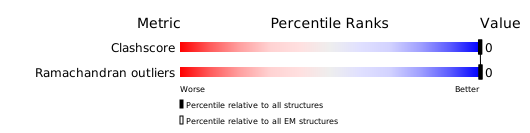
構造検証レポート
検証レポート(詳細版) をダウンロード
をダウンロード


