






 9DLO
9DLO
Crystal structure of the monomeric form of CanA
9DLO の概要
| エントリーDOI | 10.2210/pdb9dlo/pdb |
| 分子名称 | CanA (2 entities in total) |
| 機能のキーワード | cannula-like protein, cell adhesion |
| 由来する生物種 | Pyrodictium abyssi |
| タンパク質・核酸の鎖数 | 1 |
| 化学式量合計 | 19989.49 |
| 構造登録者 | |
| 主引用文献 | Sleutel, M.,Sonani, R.R.,Miller, J.G.,Wang, F.,Gonzalez Socorro, A.,Chen, Y.,Martin, R.,Demeler, B.,Rudolph, M.J.,Alva, V.,Remaut, H.,Egelman, E.H.,Conticello, V.P. Donor strand complementation and calcium ion coordination drive the chaperone-free polymerization of archaeal cannulae. Nat Commun, 16:9082-9082, 2025 Cited by PubMed Abstract: Cannulae are structurally rigid tubular protein filaments that accumulate on the extracellular surface of archaea within the family Pyrodictiaceae during cell growth. These obligate anaerobes propagate under hyperthermophilic conditions in which cannulae form a biomatrix that interconnects and sustains cells. The persistence of cannulae in this environment suggests that these filaments display significant thermostability, which has attracted technological interest in their development as synthetic protein-based biomaterials. Here, we report cryoEM structural analyses of ex vivo and in vitro assembled recombinant cannulae. We demonstrate that the interactions between protomers in native and recombinant cannulae is based on donor strand complementation (DSC), a form of non-covalent polymerization previously observed for bacterial chaperone-usher pili. Unexpectedly, calcium ion coordination at the subunit interfaces reinforces the network of donor strand interactions in the cannulae. This study provides insight into the mechanism of assembly of cannulae and the structural origin of their high stability and rigidity. PubMed: 41083437DOI: 10.1038/s41467-025-64120-8 主引用文献が同じPDBエントリー |
| 実験手法 | X-RAY DIFFRACTION (1.95 Å) |
構造検証レポート
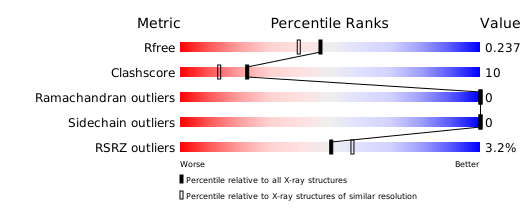
検証レポート(詳細版) をダウンロード
をダウンロード


