






 9DBV
9DBV
Cu-Bound Structure of Computationally Designed Homotetramer PW1
9DBV の概要
| エントリーDOI | 10.2210/pdb9dbv/pdb |
| 分子名称 | Computationally Designed PW1, COPPER (II) ION (3 entities in total) |
| 機能のキーワード | metalloprotein, computational design, de novo protein |
| 由来する生物種 | synthetic construct |
| タンパク質・核酸の鎖数 | 1 |
| 化学式量合計 | 12040.66 |
| 構造登録者 | |
| 主引用文献 | Hoffnagle, A.M.,Herold, R.A.,Tsai, C.Y.,Shiau, A.A.,Britt, R.D.,Tezcan, F.A. De Novo Design of a Metalloprotein with a Synthetically Inspired Dinuclear Paddlewheel Coordination Motif. J.Am.Chem.Soc., 147:40788-40798, 2025 Cited by PubMed Abstract: A metal-centered design approach was used to design a tetrameric protein assembly, PW1, with a new-to-nature metal center inspired by the structures of transition metal paddlewheel complexes such as di-Cu tetraacetate. The structure of PW1 matches the design prediction with atomic accuracy, preorganizing four Glu residues to form the desired dinuclear Cu center. Notably, Cu-PW1 has a reduction potential of -0.085 V at pH 7.0, which is more negative than any natural or engineered Cu redox protein. In addition to Cu, PW1 can also scaffold Rh ions in the dinuclear paddlewheel geometry as well as trivalent lanthanide ions in a mononuclear fashion. These results demonstrate the feasibility of designing new protein architectures around synthetically inspired, nonbiological metal centers, thus expanding the scope of artificial metalloproteins beyond those constructed around pre-existing protein scaffolds and opening new avenues to discover structure-function relationships outside the constraints of natural evolution. PubMed: 41143657DOI: 10.1021/jacs.5c13813 主引用文献が同じPDBエントリー |
| 実験手法 | X-RAY DIFFRACTION (1.8 Å) |
構造検証レポート
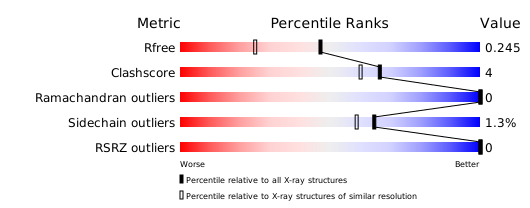
検証レポート(詳細版) をダウンロード
をダウンロード


