






 9DBL
9DBL
Full-length apo human voltage-gated sodium channel 1.8 (NaV1.8), class I
9DBL の概要
| エントリーDOI | 10.2210/pdb9dbl/pdb |
| EMDBエントリー | 46719 |
| 分子名称 | Sodium channel protein type 10 subunit alpha, beta-D-mannopyranose-(1-4)-2-acetamido-2-deoxy-beta-D-glucopyranose-(1-4)-2-acetamido-2-deoxy-beta-D-glucopyranose, 2-acetamido-2-deoxy-beta-D-glucopyranose-(1-4)-2-acetamido-2-deoxy-beta-D-glucopyranose, ... (7 entities in total) |
| 機能のキーワード | ion channel, membrane protein |
| 由来する生物種 | Homo sapiens (human) |
| タンパク質・核酸の鎖数 | 1 |
| 化学式量合計 | 237945.59 |
| 構造登録者 | |
| 主引用文献 | Neumann, B.,McCarthy, S.,Gonen, S. Structural basis of inhibition of human Na V 1.8 by the tarantula venom peptide Protoxin-I. Nat Commun, 16:1459-1459, 2025 Cited by PubMed Abstract: Voltage-gated sodium channels (Nas) selectively permit diffusion of sodium ions across the cell membrane and, in excitable cells, are responsible for propagating action potentials. One of the nine human Na isoforms, Na1.8, is a promising target for analgesics, and selective inhibitors are of interest as therapeutics. One such inhibitor, the gating-modifier peptide Protoxin-I derived from tarantula venom, blocks channel opening by shifting the activation voltage threshold to more depolarized potentials, but the structural basis for this inhibition has not previously been determined. Using monolayer graphene grids, we report the cryogenic electron microscopy structures of full-length human apo-Na1.8 and the Protoxin-I-bound complex at 3.1 Å and 2.8 Å resolution, respectively. The apo structure shows an unexpected movement of the Domain I S4-S5 helix, and VSD was unresolvable. We find that Protoxin-I binds to and displaces the VSD S3-S4 linker, hindering translocation of the S4 helix during activation. PubMed: 39920100DOI: 10.1038/s41467-024-55764-z 主引用文献が同じPDBエントリー |
| 実験手法 | ELECTRON MICROSCOPY (3.24 Å) |
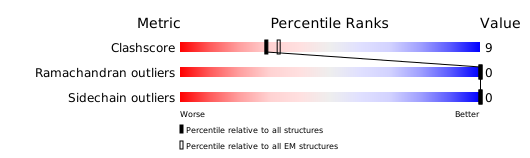
構造検証レポート
検証レポート(詳細版) をダウンロード
をダウンロード


