






 9D9V
9D9V
X-Ray structure of ALX4 homeodomain
9D9V の概要
| エントリーDOI | 10.2210/pdb9d9v/pdb |
| 分子名称 | Homeobox protein aristaless-like 4, 1,2-ETHANEDIOL (3 entities in total) |
| 機能のキーワード | alx4, paired-like homeodomain, transcription factor, transcription |
| 由来する生物種 | Homo sapiens (human) |
| タンパク質・核酸の鎖数 | 1 |
| 化学式量合計 | 10062.38 |
| 構造登録者 | |
| 主引用文献 | Cain, B.,Yuan, Z.,Thoman, E.,Kovall, R.A.,Gebelein, B. The ALX4 dimer structure provides insight into how disease alleles impact function. Nat Commun, 16:4800-4800, 2025 Cited by PubMed Abstract: How homeodomain proteins gain sufficient DNA binding specificity to regulate diverse processes is a long-standing question. Here, we determine how the ALX4 Paired-like protein achieves DNA binding specificity for a TAAT-NNN-ATTA dimer site. We first show that ALX4 binds this motif independently of its co-factor, TWIST1, in cranial neural crest cells. Structural analysis identifies seven ALX4 residues that participate in dimer binding, many of which are conserved across the Paired-like family, but not other homeodomain proteins. Unexpectedly, the two ALX4 proteins within the dimer use distinct residues to form asymmetric protein-protein and protein-DNA interactions and mediate cooperativity. Moreover, we find that ALX4 cooperativity is required for transcriptional activation and that ALX4 disease variants cause distinct molecular defects that include loss of cooperativity. These findings provide insights into how Paired-like factors gain DNA specificity and show how disease variants can be stratified based on their molecular defects. PubMed: 40410151DOI: 10.1038/s41467-025-59728-9 主引用文献が同じPDBエントリー |
| 実験手法 | X-RAY DIFFRACTION (2.39 Å) |
構造検証レポート
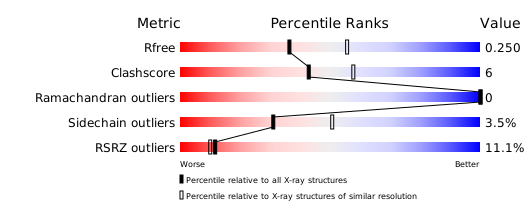
検証レポート(詳細版) をダウンロード
をダウンロード


