






9D7V
The spd-bound structure
9D7V の概要
| エントリーDOI | 10.2210/pdb9d7v/pdb |
| EMDBエントリー | 46617 |
| 分子名称 | Green fluorescence protein,MFS-type transporter SLC18B1,membrane protein spd, SPERMIDINE (3 entities in total) |
| 機能のキーワード | membrane protein |
| 由来する生物種 | Homo sapiens (human) 詳細 |
| タンパク質・核酸の鎖数 | 1 |
| 化学式量合計 | 82265.01 |
| 構造登録者 | |
| 主引用文献 | Guo, Y.,Yang, G.,Liu, H.,Chai, J.,Chen, J.,Shanklin, J.,Liu, Q.,Liu, B.,Lu, M. Structure and mechanism of human vesicular polyamine transporter. Nat Commun, 16:4142-4142, 2025 Cited by PubMed Abstract: Polyamines play essential roles in gene expression and modulate neuronal transmission in mammals. Vesicular polyamine transporters (VPAT) from the SLC18 family exploit the transmembrane H gradient to translocate polyamines into secretory vesicles, enabling the quantal release of polyamine neuromodulators and underpinning learning and memory formation. Here, we report the cryo-electron microscopy structures of human VPAT in complex with spermine, spermidine, H, or tetrabenazine, elucidating discrete lumen-facing states of the antiporter and pivotal interactions between VPAT and its substrate or inhibitor. Leveraging structure-inspired mutagenesis studies and protein structure prediction, we deduce an unforeseen mechanism whereby the polyamine and H compete for multiple acidic protein residues both directly and indirectly, and rationalize how the antidopaminergic therapeutic tetrabenazine impedes vesicular transport of polyamines. This study unravels the mechanism of an H-coupled polyamine antiporter, reveals mechanistic diversity between VPAT and other SLC18 antiporters, and raises new prospects for combating human disorders of polyamine homeostasis. PubMed: 40319071DOI: 10.1038/s41467-025-59549-w 主引用文献が同じPDBエントリー |
| 実験手法 | ELECTRON MICROSCOPY (3.3 Å) |
構造検証レポート
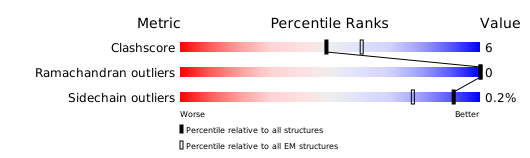
検証レポート(詳細版) をダウンロード
をダウンロード


