






 9CSV
9CSV
Streptavidin-E101Q-S112Y-K121A bound to Cu(II)-biotin-ethyl-dipicolylamine cofactor, oxidized by hydrogen peroxide
9CSV の概要
| エントリーDOI | 10.2210/pdb9csv/pdb |
| 関連するPDBエントリー | 9CST 9CSU 9CSW |
| 分子名称 | Streptavidin, N-(2-{bis[(pyridin-2-yl)methyl]amino}ethyl)-5-[(3aS,4S,6aR)-2-oxohexahydro-1H-thieno[3,4-d]imidazol-4-yl]pentanamide, COPPER (II) ION, ... (4 entities in total) |
| 機能のキーワード | biotin-streptavidin complex, artificial metalloprotein, metal binding protein |
| 由来する生物種 | Streptomyces avidinii |
| タンパク質・核酸の鎖数 | 1 |
| 化学式量合計 | 17119.19 |
| 構造登録者 | |
| 主引用文献 | Uyeda, K.S.,Follmer, A.H.,Borovik, A.S. Selective oxidation of active site aromatic residues in engineered Cu proteins. Chem Sci, 16:98-103, 2024 Cited by PubMed Abstract: Recent studies have revealed critical roles for the local environments surrounding metallocofactors, such as the newly identified Cu site in particulate methane monooxygenases (pMMOs) and the second sphere aromatic residues in lytic polysaccharide monooxygenases (LPMOs), implicated in the protection against oxidative damage. However, these features are subjects of continued debate. Our work utilizes biotin-streptavidin (Sav) technology to develop artificial metalloproteins (ArMs) that mimic the active sites of natural copper metalloenzymes. By engineering ArMs with aromatic residues within their secondary coordination spheres, we systematically investigate the influence of these residues on Cu reactivity and oxidant activation. We demonstrate that the placement and orientation of tyrosine relative to the Cu cofactor critically affect the oxidation outcomes upon exposure to hydrogen peroxide. A key finding is the interplay between the coordination of an active site asparagine and the incorporation of aromatic residues proximal to the artificial Cu cofactor, which are the only variants where oxidation of an engineered residues is observed. These findings underscore the importance of the secondary coordination sphere in modulating Cu center reactivity, suggest a role for amide coordination in C-H bond activation by pMMOs, and potential inactivation pathways in natural copper enzymes like LPMOs. PubMed: 39600509DOI: 10.1039/d4sc06667g 主引用文献が同じPDBエントリー |
| 実験手法 | X-RAY DIFFRACTION (1.6 Å) |
構造検証レポート
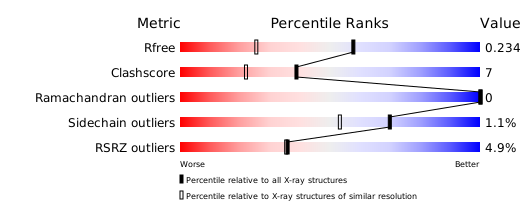
検証レポート(詳細版) をダウンロード
をダウンロード


