






 9CKK
9CKK
Cryo-EM structure of acetylated alpha-synuclein A53T fibril - polymorph A
9CKK の概要
| エントリーDOI | 10.2210/pdb9ckk/pdb |
| EMDBエントリー | 45650 |
| 分子名称 | Alpha-synuclein (1 entity in total) |
| 機能のキーワード | amyloid, neurodegeneration, aggregrate, protein fibril |
| 由来する生物種 | Homo sapiens (human) |
| タンパク質・核酸の鎖数 | 8 |
| 化学式量合計 | 116049.09 |
| 構造登録者 | |
| 主引用文献 | Ansari, S.,Lagasca, D.,Dumarieh, R.,Xiao, Y.,Krishna, S.,Li, Y.,Frederick, K.K. In cell NMR reveals cells selectively amplify and structurally remodel amyloid fibrils. Biorxiv, 2024 Cited by PubMed Abstract: Amyloid forms of α-synuclein adopt different conformations depending on environmental conditions. Advances in structural biology have accelerated fibril characterization. However, it remains unclear which conformations predominate in biological settings because current methods typically not only require isolating fibrils from their native environments, but they also do not provide insight about flexible regions. To address this, we characterized α-syn amyloid seeds and used sensitivity enhanced nuclear magnetic resonance to investigate the amyloid fibrils resulting from seeded amyloid propagation in different settings. We found that the amyloid fold and conformational preferences of flexible regions are faithfully propagated and in cellular lysates. However, seeded propagation of amyloids inside cells led to the minority conformation in the seeding population becoming predominant and more ordered, and altered the conformational preferences of flexible regions. The examination of the entire ensemble of protein conformations in biological settings that is made possible with this approach may advance our understanding of protein misfolding disorders and facilitate structure-based drug design efforts. PubMed: 39314304DOI: 10.1101/2024.09.09.612142 主引用文献が同じPDBエントリー |
| 実験手法 | ELECTRON MICROSCOPY (2.21 Å) |
構造検証レポート
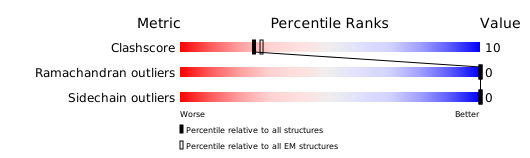
検証レポート(詳細版) をダウンロード
をダウンロード


