






9CFN
Crystal structure of an exoribonuclease-resistant RNA from a Tombusvirus-like associated RNA
9CFN の概要
| エントリーDOI | 10.2210/pdb9cfn/pdb |
| 分子名称 | RNA (59-MER), IRIDIUM HEXAMMINE ION, MAGNESIUM ION (3 entities in total) |
| 機能のキーワード | xrrna, pseudoknot, rna |
| 由来する生物種 | Beet western yellows ST9 associated virus |
| タンパク質・核酸の鎖数 | 2 |
| 化学式量合計 | 45138.92 |
| 構造登録者 | Gezelle, J.,Wimberly, B.,Gong, Z.,Steckelberg, A.L. (登録日: 2024-06-27, 公開日: 2025-07-16, 最終更新日: 2025-09-10) |
| 主引用文献 | Gezelle, J.G.,Korn, S.M.,McDonald, J.T.,Gong, Z.,Erickson, A.,Huang, C.H.,Yang, F.,Cronin, M.,Kuo, Y.W.,Wimberly, B.T.,Steckelberg, A.L. A conserved viral RNA fold enables nuclease resistance across kingdoms of life. Nucleic Acids Res., 53:-, 2025 Cited by PubMed Abstract: Viral exoribonuclease-resistant RNA (xrRNA) structures block cellular nucleases to produce subgenomic viral RNAs during infection. High sequence variability among xrRNAs from distantly related viruses raises questions about the shared molecular features that enable these RNAs to withstand the strong unwinding forces of exoribonucleases. Here, we present the first structure of a plant-virus xrRNA in its active conformation and uncover universal principles of xrRNA folding. Comparison with the structure of a human-pathogenic flavivirus xrRNA reveals that both share a core structural motif-a protective ring encircling the RNA's 5' end-despite lacking sequence similarity. Disrupting this core motif through targeted mutagenesis eliminates exoribonuclease-resistance and attenuates viral infection. We identify hundreds of related structures across multiple virus families, supporting the conservation of this mechanism. Our study demonstrates how distantly related RNA viruses have converged on a common structural strategy to inhibit cellular nucleases, with a universal ring topology as the defining feature of viral xrRNAs. PubMed: 40884403DOI: 10.1093/nar/gkaf840 主引用文献が同じPDBエントリー |
| 実験手法 | X-RAY DIFFRACTION (2.9 Å) |
構造検証レポート
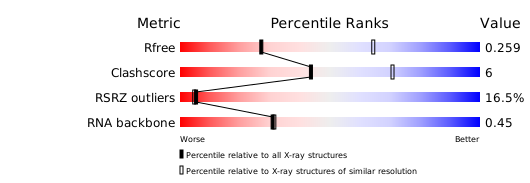
検証レポート(詳細版) をダウンロード
をダウンロード


