






 9CD4
9CD4
Cryo-EM structure of Candidatus Saccharibacterium phosphoketolase complexed with 2-acetyl-thiamine diphosphate
9CD4 の概要
| エントリーDOI | 10.2210/pdb9cd4/pdb |
| 関連するPDBエントリー | 9CD3 |
| EMDBエントリー | 45461 45462 |
| 分子名称 | Phosphoketolase family protein, 2-ACETYL-THIAMINE DIPHOSPHATE (2 entities in total) |
| 機能のキーワード | acetyl-phosphate synthase, glycolaldehyde dehydration, carbohydrate metabolic process, aldehyde-lyase activity, lyase |
| 由来する生物種 | Candidatus Saccharibacteria bacterium |
| タンパク質・核酸の鎖数 | 2 |
| 化学式量合計 | 181549.03 |
| 構造登録者 | |
| 主引用文献 | Landwehr, G.M.,Vogeli, B.,Tian, C.,Singal, B.,Gupta, A.,Lion, R.,Sargent, E.H.,Karim, A.S.,Jewett, M.C. A synthetic cell-free pathway for biocatalytic upgrading of one-carbon substrates. Biorxiv, 2024 Cited by PubMed Abstract: Biotechnological processes hold tremendous potential for the efficient and sustainable conversion of one-carbon (C1) substrates into complex multi-carbon products. However, the development of robust and versatile biocatalytic systems for this purpose remains a significant challenge. In this study, we report a hybrid electrochemical-biochemical cell-free system for the conversion of C1 substrates into the universal biological building block acetyl-CoA. The synthetic reductive formate pathway (ReForm) consists of five core enzymes catalyzing non-natural reactions that were established through a cell-free enzyme engineering platform. We demonstrate that ReForm works in a plug-and-play manner to accept diverse C1 substrates including CO equivalents. We anticipate that ReForm will facilitate efforts to build and improve synthetic C1 utilization pathways for a formate-based bioeconomy. PubMed: 39149402DOI: 10.1101/2024.08.08.607227 主引用文献が同じPDBエントリー |
| 実験手法 | ELECTRON MICROSCOPY (2.3 Å) |
構造検証レポート
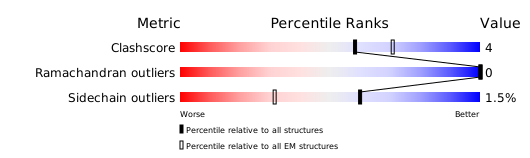
検証レポート(詳細版) をダウンロード
をダウンロード


