






 9CCB
9CCB
X-ray crystal structure of methyl-coenzyme M reductase glutamine methylase (MgmA) from Methanothermobacter marburgensis with hydroxycobalamin
9CCB の概要
| エントリーDOI | 10.2210/pdb9ccb/pdb |
| 分子名称 | Radical SAM core domain-containing protein, IRON/SULFUR CLUSTER, COBALAMIN, ... (5 entities in total) |
| 機能のキーワード | methyltransferase, radical sam, metalloenzyme, transferase |
| 由来する生物種 | Methanothermobacter marburgensis |
| タンパク質・核酸の鎖数 | 1 |
| 化学式量合計 | 52109.21 |
| 構造登録者 | |
| 主引用文献 | Rodriguez Carrero, R.J.,Lloyd, C.T.,Borkar, J.,Nath, S.,Mirica, L.M.,Nair, S.,Booker, S.J.,Metcalf, W. Genetic and biochemical characterization of a radical SAM enzyme required for post-translational glutamine methylation of methyl-coenzyme M reductase. Mbio, 16:e0354624-e0354624, 2025 Cited by PubMed Abstract: Methyl-coenzyme M reductase (MCR), the key catalyst in the anoxic production and consumption of methane, contains an unusual 2-methylglutamine residue within its active site. data show that a B12-dependent radical SAM (rSAM) enzyme, designated MgmA, is responsible for this post-translational modification (PTM). Here, we show that two different MgmA homologs are able to methylate MCR when expressed in , an organism that does not normally possess this PTM. strains expressing MgmA showed small, but significant, reductions in growth rates and yields on methylotrophic substrates. Structural characterization of the Ni(II) form of Gln-methylated MCR revealed no significant differences in the protein fold between the modified and unmodified enzyme; however, the purified enzyme contained the heterodisulfide reaction product, as opposed to the free cofactors found in eight prior MCR structures, suggesting that substrate/product binding is altered in the modified enzyme. Structural characterization of MgmA revealed a fold similar to other B12-dependent rSAMs, with a wide active site cleft capable of binding an McrA peptide in an extended, linear conformation.IMPORTANCEMethane plays a key role in the global carbon cycle and is an important driver of climate change. Because MCR is responsible for nearly all biological methane production and most anoxic methane consumption, it plays a major role in setting the atmospheric levels of this important greenhouse gas. Thus, a detailed understanding of this enzyme is critical for the development of methane mitigation strategies. PubMed: 39772843DOI: 10.1128/mbio.03546-24 主引用文献が同じPDBエントリー |
| 実験手法 | X-RAY DIFFRACTION (2.08 Å) |
構造検証レポート
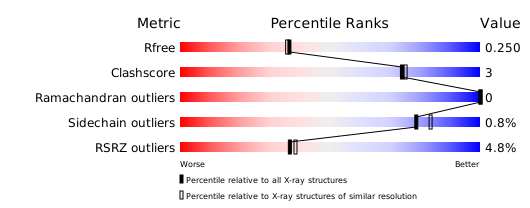
検証レポート(詳細版) をダウンロード
をダウンロード


