






 9CBB
9CBB
Structure of urate bound human SLC2A9 transporter
9CBB の概要
| エントリーDOI | 10.2210/pdb9cbb/pdb |
| EMDBエントリー | 45421 |
| 分子名称 | Soluble cytochrome b562,Solute carrier family 2, facilitated glucose transporter member 9, URIC ACID (2 entities in total) |
| 機能のキーワード | transporter, membrane protein |
| 由来する生物種 | Homo sapiens (human) 詳細 |
| タンパク質・核酸の鎖数 | 1 |
| 化学式量合計 | 70027.81 |
| 構造登録者 | |
| 主引用文献 | Khandelwal, N.K.,Gupta, M.,Kumar, P.,Balasubramani, S.G.,Echeverria, I.,Stroud, R.M. Structural basis of disease mutation and substrate recognition by the human SLC2A9 transporter. Proc.Natl.Acad.Sci.USA, 122:e2418282122-e2418282122, 2025 Cited by PubMed Abstract: Urate provides ~50% of the reducing potential in human and primate plasma which is key to detoxifying reactive oxygen by-products of cellular metabolism. Urate is the endpoint of purine metabolism in primates, and its concentration in plasma is a balance between excretion from kidney and intestine, and subsequent reabsorption in and through cells of kidney proximal tubules to maintain a regulated concentration in plasma. SLC2A9 is the primary transporter that returns urate from the basolateral side of kidney tubule cells back to plasma. A shorter splice variant of SLC2A9 is directed to the apical surface where several transporters recapture urate from the tubule back into cells. Too high a concentration in plasma causes hyperuricemia, is linked to gout, and favors kidney stone formation. To understand the molecular basis of uric acid transport and the role of disease-causing mutations in SLC2A9, we determined structures of human SLC2A9 in its apo form, and its urate-bound form by cryo-EM, at resolution of 3.3 Å and 4.1 Å respectively. Both structures are captured in an inward open conformation. Using the inward-facing structure as a template we modeled the outward-facing conformation to understand the alternating access mechanism. Alternative salt bridge pairs on the cytoplasmic side suggest a mechanism that can balance the energetics of the inward open and outward open states. The location of disease-causing mutants suggests their role in impacting function. Our structures elucidate the molecular basis for urate selectivity and transport and provide a platform for future structure-based drug discovery aimed at reducing plasma urate levels in diseases of hyperuricemia and gout. PubMed: 39937868DOI: 10.1073/pnas.2418282122 主引用文献が同じPDBエントリー |
| 実験手法 | ELECTRON MICROSCOPY (4.15 Å) |
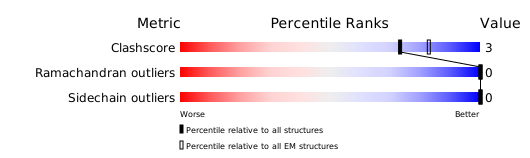
構造検証レポート
検証レポート(詳細版) をダウンロード
をダウンロード


