






9C9A
Crystal structure of AprG complexed with a GlcNAc analog inhibitor
This is a non-PDB format compatible entry.
Summary for 9C9A
| Entry DOI | 10.2210/pdb9c9a/pdb |
| Related | 9C95 9C99 |
| Descriptor | AprG, 2-acetamido-2,3-dideoxy-D-ribo-hexitol (3 entities in total) |
| Functional Keywords | transaldolase, schiff base, bicyclic octose formation, transferase |
| Biological source | Streptoalloteichus tenebrarius More |
| Total number of polymer chains | 2 |
| Total formula weight | 74635.23 |
| Authors | Kim, W.,Zhang, Y.J. (deposition date: 2024-06-13, release date: 2025-08-06, Last modification date: 2025-09-10) |
| Primary citation | Kim, W.,Fan, P.H.,Bu, J.,Liu, H.W.,Zhang, Y.J. Structure-Guided Mechanistic Investigation of Stereochemical Inversion during the Octose Formation Catalyzed by an Atypical Transaldolase AprG in the Biosynthesis of Apramycin. Acs Catalysis, 15:13778-13786, 2025 Cited by PubMed Abstract: Transaldolases are essential enzymes across all life domains, facilitating the exchange of aldol fragments in metabolic processes. AprG, a transaldolase in the apramycin biosynthetic pathway, catalyzes the incorporation of C7' and C8' moieties into the bicyclic octose core. Unlike canonical transaldolases, the AprG product exhibits unique stereochemical inversion, whose mechanism remains unclear. Here, by taking snapshots of AprG at different stages of the reaction, we identified active site residues essential for each reaction step. Strikingly, we discovered a 7'-epimer of the AprG product, directly implicating this inversion in the enzyme's mechanism and uncovering a key aspect of product inhibition. This unexpected epimer sheds a light on the stereochemical plasticity of transaldolases. Additionally, donor analogue studies provided insights into substrate recognition. These findings enhance our mechanistic understanding of AprG and suggest strategies for engineering biocatalysts with tailored stereochemical properties. More broadly, this work provides a framework for modifying transaldolase activity, expanding its potential applications in chemoenzymatic synthesis and metabolic engineering. PubMed: 40855890DOI: 10.1021/acscatal.5c03420 PDB entries with the same primary citation |
| Experimental method | X-RAY DIFFRACTION (1.61 Å) |
Structure validation
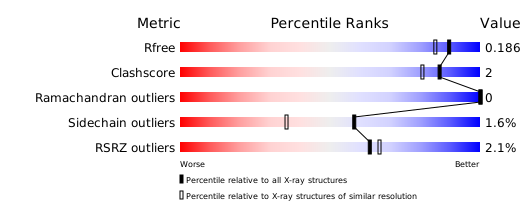
Download full validation report


