






9C7Z
Hallucinated C3 protein assembly HALC3_919
Summary for 9C7Z
| Entry DOI | 10.2210/pdb9c7z/pdb |
| Descriptor | HALC3_919, TETRAETHYLENE GLYCOL (3 entities in total) |
| Functional Keywords | trimer, hallucination, de novo, de novo protein |
| Biological source | synthetic construct |
| Total number of polymer chains | 2 |
| Total formula weight | 16350.76 |
| Authors | Ragotte, R.,Bera, A.,Milles, L.F.,Wicky, B.I.M.,Baker, D. (deposition date: 2024-06-11, release date: 2025-05-21, Last modification date: 2025-12-10) |
| Primary citation | Ragotte, R.J.,Tortorici, M.A.,Catanzaro, N.J.,Addetia, A.,Coventry, B.,Froggatt, H.M.,Lee, J.,Stewart, C.,Brown, J.T.,Goreshnik, I.,Sims, J.N.,Milles, L.F.,Wicky, B.I.M.,Glogl, M.,Gerben, S.,Kang, A.,Bera, A.K.,Sharkey, W.,Schafer, A.,Harkema, J.R.,Baric, R.S.,Baker, D.,Veesler, D. Designed miniproteins potently inhibit and protect against MERS-CoV. Cell Rep, 44:115760-115760, 2025 Cited by PubMed Abstract: Middle East respiratory syndrome coronavirus (MERS-CoV) is a zoonotic pathogen with a 36% case-fatality rate in humans. No vaccines or specific therapeutics are currently approved for use in humans or the camel host reservoir. Here, we computationally designed monomeric and homo-oligomeric miniproteins that bind with high affinity to the MERS-CoV spike (S) glycoprotein, the main target of neutralizing antibodies and vaccine development. We show that these miniproteins broadly neutralize a panel of MERS-CoV S variants, spanning the known antigenic diversity of this pathogen, by targeting a conserved site in the receptor-binding domain (RBD). The miniproteins directly compete with binding of the dipeptidylpeptidase 4 (DPP4) receptor to MERS-CoV S, thereby blocking viral attachment to the host entry receptor and subsequent membrane fusion. Intranasal administration of a lead miniprotein provides prophylactic protection against stringent MERS-CoV challenge in mice, motivating its future clinical development as a next-generation countermeasure against this virus with pandemic potential. PubMed: 40450691DOI: 10.1016/j.celrep.2025.115760 PDB entries with the same primary citation |
| Experimental method | X-RAY DIFFRACTION (2.1 Å) |
Structure validation
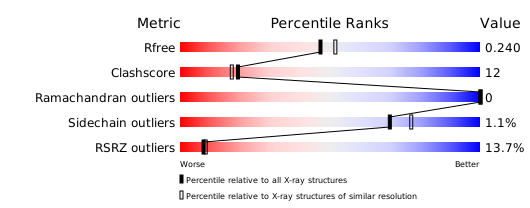
Download full validation report


