






 9C5T
9C5T
Cryo EM structure of DCAF2
9C5T の概要
| エントリーDOI | 10.2210/pdb9c5t/pdb |
| EMDBエントリー | 45224 |
| 分子名称 | Denticleless protein homolog, DNA damage-binding protein 1 (2 entities in total) |
| 機能のキーワード | dcaf2, e3 ligase, dtl, ddb1, ligase |
| 由来する生物種 | Homo sapiens (human) 詳細 |
| タンパク質・核酸の鎖数 | 2 |
| 化学式量合計 | 178984.59 |
| 構造登録者 | |
| 主引用文献 | McMahon, E.J.,Cioffi, A.G.,Visperas, P.R.,Lin, Y.,Shaghafi, M.,Daczkowski, C.M.,Hermann, J.C.,Everley, R.A.,Neve, R.M.,Erlanson, D.A.,Webster, K.R.,Narayan, V.,Wang, W. Structural basis for DCAF2 as a novel E3 ligase for PROTAC-mediated targeted protein degradation. Structure, 33:2020-2028.e7, 2025 Cited by PubMed Abstract: Targeted protein degradation (TPD) leverages the ubiquitin-proteasome system to eliminate disease-causing proteins via E3 ligases. To date, the field is limited to utilizing a few of the over 600 human E3 ligases. To expand this repertoire, we conducted structural and functional validation of DDB1 (Damage-specific DNA binding protein 1) and Cullin-associated factor (DCAF)2 (DTL/CDT2), a Cullin4-RING ligase substrate adaptor implicated in DNA damage response and cancer, as a novel E3 for TPD. Cryoelectron microscopy (cryo-EM) structures of the DCAF2:DDB1:DDA1 complex (3.3 Å), a ligand bound complex (3.1 Å), and a ternary complex with a covalent proteolysis-targeting chimera (PROTAC) and BRD4 (3.4 Å) reveal PROTAC-mediated substrate recruitment. Using covalent bifunctional tool compounds engaging residue C141 in the WD40 domain, we demonstrate robust ubiquitination in biochemical assays and cellular TPD using the COFFEE (covalent functionalization followed by E3 electroporation) method. These findings position DCAF2 as a promising E3 adaptor for PROTAC strategies and identify C141 as a relevant site for future PROTAC discovery. PubMed: 41045927DOI: 10.1016/j.str.2025.09.006 主引用文献が同じPDBエントリー |
| 実験手法 | ELECTRON MICROSCOPY (3.36 Å) |
構造検証レポート
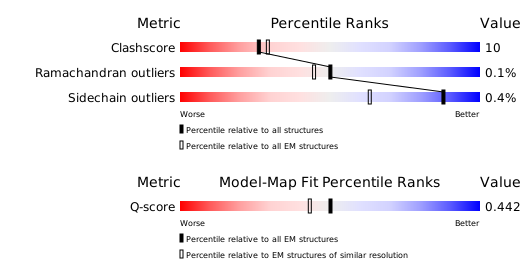
検証レポート(詳細版) をダウンロード
をダウンロード


