






 9BYS
9BYS
Structure of human MAIT BV28 TCR in complex with human MR1-5-OP-RU
This is a non-PDB format compatible entry.
Summary for 9BYS
| Entry DOI | 10.2210/pdb9bys/pdb |
| Descriptor | Major histocompatibility complex class I-related gene protein, TCR beta chain, TCR alpha chain, ... (7 entities in total) |
| Functional Keywords | antigen presentation, mait cells, t cell receptor, mr1, immune system |
| Biological source | Homo sapiens (human) More |
| Total number of polymer chains | 4 |
| Total formula weight | 94915.21 |
| Authors | Awad, W.,Rossjohn, J. (deposition date: 2024-05-24, release date: 2025-06-11, Last modification date: 2025-12-24) |
| Primary citation | Awad, W.,Gherardin, N.A.,Ciacchi, L.,Keller, A.N.,Liu, L.,Fairlie, D.P.,McCluskey, J.,Godfrey, D.I.,Rossjohn, J. A molecular basis underpinning TRBV28 + T-cell receptor recognition of MR1-antigen. J.Biol.Chem., 301:110416-110416, 2025 Cited by PubMed Abstract: Mucosal-associated invariant T (MAIT) cells express a TRAV1-2 T-cell receptor (TCR) that recognizes microbial vitamin B2 derivatives presented by the major histocompatibility complex class I-related molecule (MR1). Most MAIT TCRs incorporate a biased TCR-β repertoire, predominantly TRBV20-1 and TRBV6, but some utilize other trbv genes, including TRBV28. A second conserved, albeit less frequent TRAV36 TRBV28 T-cell population exhibits MAIT-like phenotypic features but use a markedly distinct mode of MR1-antigen (Ag) recognition compared with MAIT TCR-MR1 binding. Nevertheless, our understanding of how differing TCR gene usage results in altered MR1 binding modes remains incomplete. Here, binding studies demonstrated differential affinities and Ag specificities between TRBV6 and TRBV28 MR1-restricted TCRs. Alanine-scanning mutagenesis on the TRAV36-TRBV28 TCR revealed a strong dependence on germline-encoded residues within the highly selected complementarity-determining region 3α loop, similar to TRAV1-2-TRBV6 TCRs, and further alanine-scanning mutagenesis experiments demonstrate differential energetic footprints by these TCRs atop MR1. We determined the crystal structure of a MAIT TRAV1-2-TRBV28 TCR-MR1-5-OP-RU ternary complex. This structure revealed a docking mode conserved amongst other TRAV1-2 MAIT TCRs, with the trbv28-encoded TCR-β chain adopting highly distinct docking modes between the TRAV1-2 and TRAV36 TCRs. This indicates that the TCR-α chain dictates the positioning and role of the TCR-β chain. Taken together, these findings provide new molecular insights into MR1-Ag-driven selection of paired TCR-α and TCR-β chains. PubMed: 40570962DOI: 10.1016/j.jbc.2025.110416 PDB entries with the same primary citation |
| Experimental method | X-RAY DIFFRACTION (3.1 Å) |
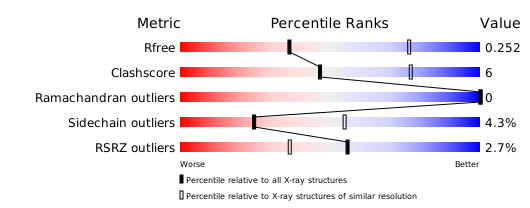
Structure validation
Download full validation report


