






 9BTQ
9BTQ
Cryo-EM structure of extracellular tube from Microcystis Aeruginosa pcc 7806SL
9BTQ の概要
| エントリーDOI | 10.2210/pdb9btq/pdb |
| EMDBエントリー | 44895 |
| 分子名称 | pilin (1 entity in total) |
| 機能のキーワード | extracellular tube, filament, pili, helical symmetry, protein fibril |
| 由来する生物種 | Microcystis aeruginosa PCC 7806SL |
| タンパク質・核酸の鎖数 | 1 |
| 化学式量合計 | 15515.28 |
| 構造登録者 | Petersen, H.A.,Ricca, J.G.,Louda, J.W.,Wang, F. (登録日: 2024-05-15, 公開日: 2025-05-14, 最終更新日: 2025-09-17) |
| 主引用文献 | Ricca, J.G.,Petersen, H.A.,Grosvirt-Dramen, A.,Mayali, X.,Naylon, S.H.,Duersch, B.G.,Dufresne, C.P.,Weber, P.K.,Sonani, R.R.,Prevelige, P.E.,Hochbaum, A.I.,Merk, V.,Louda, J.W.,Wang, F. A family of tubular pili from harmful algal bloom forming cyanobacterium Microcystis aeruginosa. Nat Commun, 16:8082-8082, 2025 Cited by PubMed Abstract: Cyanobacteria are vital photosynthetic prokaryotes, but some form harmful algal blooms (cyanoHABs) that disrupt ecosystems and produce toxins. The mechanisms by which these blooms form have yet to be fully understood, particularly the role of extracellular components. Here, we present a 2.4 Å cryo-EM structure of a pilus, termed the cyanobacterial tubular (CT) pilus, found in the cyanoHAB-forming Microcystis aeruginosa. The pilin exhibits a unique protein fold, forming a tubular pilus structure with tight, double-layer anti-parallel β-sheet interactions. We show that CT pili are essential for buoyancy by facilitating the formation of micro-colonies, which increases drag force and prevents sinking. The CT pilus surface is heavily glycosylated with ten monosaccharide modifications per pilin. Furthermore, CT pili can enrich microcystin, potentially enhancing cellular resilience, and co-localize with iron-enriched extracellular matrix components. Thus, we propose that this pilus plays an important role in the proliferation of cyanoHABs. This just discovered pilus family appears to be widely distributed across several cyanobacterial orders. Our structural and functional characterization of CT pili provide insights into cyanobacterial cell morphology, physiology, and toxin interactions, and identify potential targets for disrupting bloom formation. PubMed: 40883291DOI: 10.1038/s41467-025-63379-1 主引用文献が同じPDBエントリー |
| 実験手法 | ELECTRON MICROSCOPY (2.4 Å) |
構造検証レポート
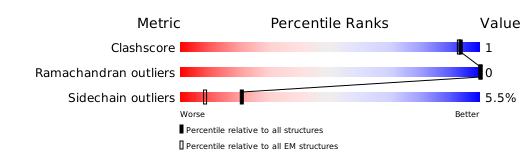
検証レポート(詳細版) をダウンロード
をダウンロード


