






9BL1
Crystal structure of heme-binding protein from Populus trichocarpa
Summary for 9BL1
| Entry DOI | 10.2210/pdb9bl1/pdb |
| Descriptor | Heme-binding protein, PtHOZ1, NICKEL (II) ION (3 entities in total) |
| Functional Keywords | heme binding protein, split-barrel family, sad phasing, metal binding protein |
| Biological source | Populus trichocarpa (black cottonwood) |
| Total number of polymer chains | 1 |
| Total formula weight | 32558.87 |
| Authors | |
| Primary citation | Grosjean, N.,Zhang, L.,Kumaran, D.,Xie, M.,Fahey, A.,Santiago, K.,Hu, F.,Regulski, M.,Blaby, I.K.,Ware, D.,Blaby-Haas, C.E. Functional diversification within the heme-binding split-barrel family. J.Biol.Chem., 300:107888-107888, 2024 Cited by PubMed Abstract: Due to neofunctionalization, a single fold can be identified in multiple proteins that have distinct molecular functions. Depending on the time that has passed since gene duplication and the number of mutations, the sequence similarity between functionally divergent proteins can be relatively high, eroding the value of sequence similarity as the sole tool for accurately annotating the function of uncharacterized homologs. Here, we combine bioinformatic approaches with targeted experimentation to reveal a large multifunctional family of putative enzymatic and nonenzymatic proteins involved in heme metabolism. This family (homolog of HugZ (HOZ)) is embedded in the "FMN-binding split barrel" superfamily and contains separate groups of proteins from prokaryotes, plants, and algae, which bind heme and either catalyze its degradation or function as nonenzymatic heme sensors. In prokaryotes these proteins are often involved in iron assimilation, whereas several plant and algal homologs are predicted to degrade heme in the plastid or regulate heme biosynthesis. In the plant Arabidopsis thaliana, which contains two HOZ subfamilies that can degrade heme in vitro (HOZ1 and HOZ2), disruption of AtHOZ1 (AT3G03890) or AtHOZ2A (AT1G51560) causes developmental delays, pointing to important biological roles in the plastid. In the tree Populus trichocarpa, a recent duplication event of a HOZ1 ancestor has resulted in localization of a paralog to the cytosol. Structural characterization of this cytosolic paralog and comparison to published homologous structures suggests conservation of heme-binding sites. This study unifies our understanding of the sequence-structure-function relationships within this multilineage family of heme-binding proteins and presents new molecular players in plant and bacterial heme metabolism. PubMed: 39395795DOI: 10.1016/j.jbc.2024.107888 PDB entries with the same primary citation |
| Experimental method | X-RAY DIFFRACTION (1.8 Å) |
Structure validation
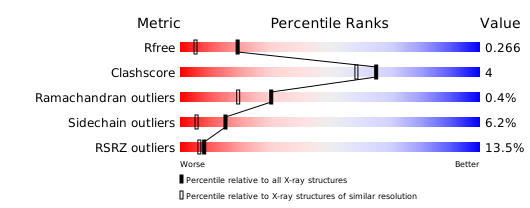
Download full validation report


