






 9BJS
9BJS
X-ray crystal structure of Y62W Thermothelomyces thermophilus polysaccharide monooxygenase 9E
9BJS の概要
| エントリーDOI | 10.2210/pdb9bjs/pdb |
| 関連するPDBエントリー | 9BJQ 9BJR |
| 分子名称 | Glycoside hydrolase family 61 protein, COPPER (II) ION, 1,2-ETHANEDIOL, ... (6 entities in total) |
| 機能のキーワード | polysaccharide monooxygenase, oxidoreductase |
| 由来する生物種 | Thermothelomyces thermophilus |
| タンパク質・核酸の鎖数 | 2 |
| 化学式量合計 | 49141.15 |
| 構造登録者 | |
| 主引用文献 | Sayler, R.I.,Thomas, W.C.,Rose, A.J.,Marletta, M.A. Electron transfer in polysaccharide monooxygenase catalysis. Proc.Natl.Acad.Sci.USA, 122:e2411229121-e2411229121, 2025 Cited by PubMed Abstract: Polysaccharide monooxygenase (PMO) catalysis involves the chemically difficult hydroxylation of unactivated C-H bonds in carbohydrates. The reaction requires reducing equivalents and will utilize either oxygen or hydrogen peroxide as a cosubstrate. Two key mechanistic questions are addressed here: 1) How does the enzyme regulate the timely and tightly controlled electron delivery to the mononuclear copper active site, especially when bound substrate occludes the active site? and 2) How does this electron delivery differ when utilizing oxygen or hydrogen peroxide as a cosubstrate? Using a computational approach, potential paths of electron transfer (ET) to the active site copper ion were identified in a representative AA9 family PMO from (PMO9E). When Y62, a buried residue 12 Å from the active site, is mutated to F, lower activity is observed with O. However, a WT-level activity is observed with HO as a cosubstrate indicating an important role in ET for O activation. To better understand the structural effects of mutations to Y62 and axial copper ligand Y168, crystal structures were solved of the wild type PMO9E and the variants Y62W, Y62F, and Y168F. A bioinformatic analysis revealed that position 62 is conserved as either Y or W in the AA9 family. The PMO9E Y62W variant has restored activity with O. Overall, the use of redox-active residues to supply electrons for the reaction with O appears to be widespread in the AA9 family. Furthermore, the results provide a molecular framework to understand catalysis with O versus HO. PubMed: 39793048DOI: 10.1073/pnas.2411229121 主引用文献が同じPDBエントリー |
| 実験手法 | X-RAY DIFFRACTION (2 Å) |
構造検証レポート
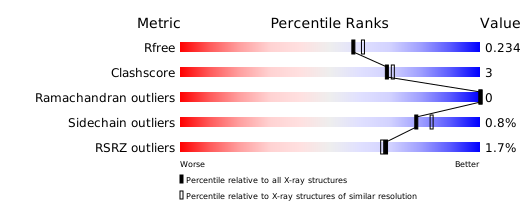
検証レポート(詳細版) をダウンロード
をダウンロード


