






 9BE3
9BE3
The pre-condensation state of the dimodular NRPS protein LgrA
This is a non-PDB format compatible entry.
Summary for 9BE3
| Entry DOI | 10.2210/pdb9be3/pdb |
| Descriptor | Linear gramicidin synthase subunit A, GLYCEROL, (2~{R})-~{N}-[3-[2-[[(2~{S})-2-formamido-3-methyl-butanoyl]amino]ethylamino]-3-oxidanylidene-propyl]-3,3-dimethyl-2-oxidanyl-4-[oxidanyl-bis(oxidanylidene)-$l^{6}-phosphanyl]oxy-butanamide, ... (6 entities in total) |
| Functional Keywords | nornribosomal peptide synthetase, condensation, peptide bond, linear gramicidin, biosynthetic protein |
| Biological source | Brevibacillus parabrevis |
| Total number of polymer chains | 2 |
| Total formula weight | 413641.46 |
| Authors | Pistofidis, A.,Schmeing, T.M. (deposition date: 2024-04-13, release date: 2024-11-20, Last modification date: 2025-02-19) |
| Primary citation | Pistofidis, A.,Ma, P.,Li, Z.,Munro, K.,Houk, K.N.,Schmeing, T.M. Structures and mechanism of condensation in non-ribosomal peptide synthesis. Nature, 638:270-278, 2025 Cited by PubMed Abstract: Non-ribosomal peptide synthetases (NRPSs) are megaenzymes responsible for the biosynthesis of many clinically important natural products, from early modern medicines (penicillin, bacitracin) to current blockbuster drugs (cubicin, vancomycin) and newly approved therapeutics (rezafungin). The key chemical step in these biosyntheses is amide bond formation between aminoacyl building blocks, catalysed by the condensation (C) domain. There has been much debate over the mechanism of this reaction. NRPS condensation has been difficult to fully characterize because it is one of many successive reactions in the NRPS synthetic cycle and because the canonical substrates are each attached transiently as thioesters to mobile carrier domains, which are often both contained in the same very flexible protein as the C domain. Here we have produced a dimodular NRPS protein in two parts, modified each with appropriate non-hydrolysable substrate analogues, assembled the two parts with protein ligation, and solved the structures of the substrate- and product-bound states. The structures show the precise orientation of the megaenzyme preparing the nucleophilic attack of its key chemical step, and enable biochemical assays and quantum mechanical simulations to precisely interrogate the reaction. These data suggest that NRPS C domains use a concerted reaction mechanism, whereby the active-site histidine likely functions not as a general base, but as a crucial stabilizing hydrogen bond acceptor for the developing ammonium. PubMed: 39662504DOI: 10.1038/s41586-024-08417-6 PDB entries with the same primary citation |
| Experimental method | X-RAY DIFFRACTION (2.9 Å) |
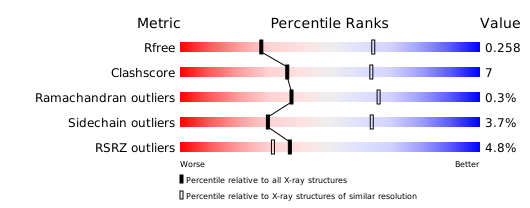
Structure validation
Download full validation report


