






 9B54
9B549B54 の概要
| エントリーDOI | 10.2210/pdb9b54/pdb |
| EMDBエントリー | 44199 |
| 分子名称 | Guanine nucleotide-binding protein G(i) subunit alpha-1, Guanine nucleotide-binding protein G(I)/G(S)/G(T) subunit beta-1, Guanine nucleotide-binding protein G(I)/G(S)/G(O) subunit gamma-2, ... (6 entities in total) |
| 機能のキーワード | g protein-coupled receptor (gpcr), g protein, gi, biased ligand, signaling protein |
| 由来する生物種 | Homo sapiens (human) 詳細 |
| タンパク質・核酸の鎖数 | 5 |
| 化学式量合計 | 169937.31 |
| 構造登録者 | Rangari, V.A.,O'Brien, E.S.,Kobilka, B.K.,Krishna Kumar, K.,Majumdar, S. (登録日: 2024-03-22, 公開日: 2025-03-05, 最終更新日: 2025-04-16) |
| 主引用文献 | Rangari, V.A.,O'Brien, E.S.,Powers, A.S.,Slivicki, R.A.,Bertels, Z.,Appourchaux, K.,Aydin, D.,Ramos-Gonzalez, N.,Mwirigi, J.,Lin, L.,Mangutov, E.,Sobecks, B.L.,Awad-Agbaria, Y.,Uphade, M.B.,Aguilar, J.,Peddada, T.N.,Shiimura, Y.,Huang, X.P.,Folarin-Hines, J.,Payne, M.,Kalathil, A.,Varga, B.R.,Kobilka, B.K.,Pradhan, A.A.,Cameron, M.D.,Kumar, K.K.,Dror, R.O.,Gereau 4th, R.W.,Majumdar, S. A cryptic pocket in CB1 drives peripheral and functional selectivity. Nature, 640:265-273, 2025 Cited by PubMed Abstract: The current opioid overdose epidemic highlights the urgent need to develop safer and more effective treatments for chronic pain. Cannabinoid receptor type 1 (CB1) is a promising non-opioid target for pain relief, but its clinical use has been limited by centrally mediated psychoactivity and tolerance. We overcame both issues by designing peripherally restricted CB1 agonists that minimize arrestin recruitment. We achieved these goals by computationally designing positively charged derivatives of the potent CB1 agonist MDMB-Fubinaca. We designed these ligands to occupy a cryptic pocket identified through molecular dynamics simulations-an extended binding pocket that opens rarely and leads to the conserved signalling residue D (ref. ). We used structure determination, pharmacological assays and molecular dynamics simulations to verify the binding modes of these ligands and to determine the molecular mechanism by which they achieve this dampening of arrestin recruitment. Our lead ligand, VIP36, is highly peripherally restricted and demonstrates notable efficacy in three mouse pain models, with 100-fold dose separation between analgesic efficacy and centrally mediated side effects. VIP36 exerts analgesic efficacy through peripheral CB1 receptors and shows limited analgesic tolerance. These results show how targeting a cryptic pocket in a G-protein-coupled receptor can lead to enhanced peripheral selectivity, biased signalling, desired in vivo pharmacology and reduced adverse effects. This has substantial implications for chronic pain treatment but could also revolutionize the design of drugs targeting other G-protein-coupled receptors. PubMed: 40044849DOI: 10.1038/s41586-025-08618-7 主引用文献が同じPDBエントリー |
| 実験手法 | ELECTRON MICROSCOPY (2.86 Å) |
構造検証レポート
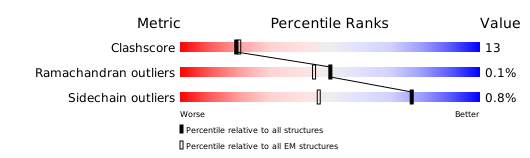
検証レポート(詳細版) をダウンロード
をダウンロード


