






 9ARN
9ARN
Structure and interactions of HIV-1 gp41 CHR-NHR reverse hairpin constructs reveal molecular determinants of antiviral activity
9ARN の概要
| エントリーDOI | 10.2210/pdb9arn/pdb |
| 関連するPDBエントリー | 8W2Y 8W32 8W37 |
| 分子名称 | Transmembrane protein gp41, SULFATE ION (3 entities in total) |
| 機能のキーワード | hiv, gp41, virus, viral protein, reverse hairpin |
| 由来する生物種 | Human immunodeficiency virus 1 |
| タンパク質・核酸の鎖数 | 1 |
| 化学式量合計 | 9651.79 |
| 構造登録者 | |
| 主引用文献 | He, L.,McAndrew, R.,Barbu, R.,Gifford, G.,Halacoglu, C.,Drouin-Allaire, C.,Weber, L.,Kristensen, L.G.,Gupta, S.,Chen, Y.,Petzold, C.J.,Allaire, M.,Li, K.H.,Ralston, C.Y.,Gochin, M. Structure and Interactions of HIV-1 gp41 CHR-NHR Reverse Hairpin Constructs Reveal Molecular Determinants of Antiviral Activity. J.Mol.Biol., 436:168650-168650, 2024 Cited by PubMed Abstract: Engineered reverse hairpin constructs containing a partial C-heptad repeat (CHR) sequence followed by a short loop and full-length N-heptad repeat (NHR) were previously shown to form trimers in solution and to be nanomolar inhibitors of HIV-1 Env mediated fusion. Their target is the in situ gp41 fusion intermediate, and they have similar potency to other previously reported NHR trimers. However, their design implies that the NHR is partially covered by CHR, which would be expected to limit potency. An exposed hydrophobic pocket in the folded structure may be sufficient to confer the observed potency, or they may exist in a partially unfolded state exposing full length NHR. Here we examined their structure by crystallography, CD and fluorescence, establishing that the proteins are folded hairpins both in crystal form and in solution. We examined unfolding in the milieu of the fusion reaction by conducting experiments in the presence of a membrane mimetic solvent and by engineering a disulfide bond into the structure to prevent partial unfolding. We further examined the role of the hydrophobic pocket, using a hairpin-small molecule adduct that occluded the pocket, as confirmed by X-ray footprinting. The results demonstrated that the NHR region nominally covered by CHR in the engineered constructs and the hydrophobic pocket region that is exposed by design were both essential for nanomolar potency and that interaction with membrane is likely to play a role in promoting the required inhibitor structure. The design concepts can be applied to other Class 1 viral fusion proteins. PubMed: 38866091DOI: 10.1016/j.jmb.2024.168650 主引用文献が同じPDBエントリー |
| 実験手法 | X-RAY DIFFRACTION (1.41 Å) |
構造検証レポート
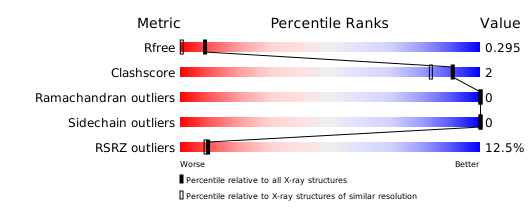
検証レポート(詳細版) をダウンロード
をダウンロード


