






 8ZWE
8ZWE
Cryo-EM structure of MRCoV RBD in complex with mink ACE2
8ZWE の概要
| エントリーDOI | 10.2210/pdb8zwe/pdb |
| EMDBエントリー | 60524 |
| 分子名称 | Spike glycoprotein, Angiotensin-converting enzyme, 2-acetamido-2-deoxy-beta-D-glucopyranose (3 entities in total) |
| 機能のキーワード | neogale vison hku5-related coronavirus, mink ace2, complex, viral protein/hydrolase, viral protein-hydrolase complex |
| 由来する生物種 | Bat coronavirus HKU5 (BtCoV, BtCoV/HKU5/2004) 詳細 |
| タンパク質・核酸の鎖数 | 2 |
| 化学式量合計 | 96055.61 |
| 構造登録者 | |
| 主引用文献 | Wang, N.,Ji, W.,Jiao, H.,Veit, M.,Sun, J.,Wang, Y.,Ma, X.,Wang, Y.,Wang, Y.,Li, X.X.,Zhang, X.,Chen, J.,Wei, J.,Xu, Y.,Guo, D.,Zhai, X.,Merits, A.,Li, C.,Rey, F.A.,Dobrikov, G.M.,Gao, G.F.,Zhang, S.,Bi, Y.,Su, S. A MERS-CoV-like mink coronavirus uses ACE2 as an entry receptor. Nature, 642:739-746, 2025 Cited by PubMed Abstract: Despite accumulating evidence that bat-derived coronaviruses often require intermediate hosts to facilitate transmission to humans, the potential role of fur animals in zoonotic coronavirus spillovers has largely been overlooked. Here we report the isolation and characterization of a previously undescribed mink respiratory coronavirus (MRCoV) from farmed minks with pneumonia. Notably, MRCoV uses angiotensin-converting enzyme 2 (ACE2) as an entry receptor and can infect mink, bat, monkey and human cells. Cryo-electron microscopy analyses revealed that the MRCoV receptor-binding domain (RBD) binds to the same interface on ACE2 receptors as the RBD of severe acute respiratory syndrome coronavirus 2 (SARS-CoV-2) despite structural differences. We identify the key determinants on the RBD of MRCoV and ACE2 that confer efficient binding. HKU5-33S, a bat coronavirus closely related to MRCoV, uses ACE2 of the bat Pipistrellus abramus for cell entry and requires only two amino acid substitutions to adapt to mink ACE2. SARS-CoV-2 protease and polymerase inhibitors potently block MRCoV infection, thereby indicating a potential therapeutic strategy. Collectively, these findings enhance our understanding of coronavirus receptor dynamics and highlight their zoonotic potential. Given the risks posed by fur farms as reservoirs for emerging pathogens, our study underscores the need for enhanced surveillance to mitigate future coronavirus outbreaks. PubMed: 40306315DOI: 10.1038/s41586-025-09007-w 主引用文献が同じPDBエントリー |
| 実験手法 | ELECTRON MICROSCOPY (3 Å) |
構造検証レポート
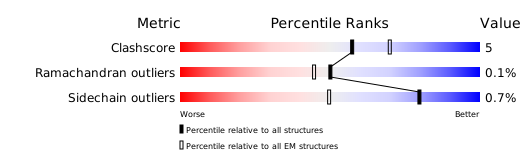
検証レポート(詳細版) をダウンロード
をダウンロード


