






 8ZCE
8ZCE
Cryo-EM structure of GPR4 complexed with Gs in pH6.0
8ZCE の概要
| エントリーDOI | 10.2210/pdb8zce/pdb |
| EMDBエントリー | 39927 |
| 分子名称 | Guanine nucleotide-binding protein G(s) subunit alpha isoforms short, Guanine nucleotide-binding protein G(I)/G(S)/G(T) subunit beta-1, Guanine nucleotide-binding protein G(I)/G(S)/G(O) subunit gamma-2, ... (5 entities in total) |
| 機能のキーワード | gpcr, gpr4, dngs, proton sensing, signaling protein, signaling protein-immune system complex, signaling protein/immune system |
| 由来する生物種 | Homo sapiens (human) 詳細 |
| タンパク質・核酸の鎖数 | 5 |
| 化学式量合計 | 148663.40 |
| 構造登録者 | |
| 主引用文献 | Yue, X.,Peng, L.,Liu, S.,Zhang, B.,Zhang, X.,Chang, H.,Pei, Y.,Li, X.,Liu, J.,Shui, W.,Wu, L.,Xu, H.,Liu, Z.J.,Hua, T. Structural basis of stepwise proton sensing-mediated GPCR activation. Cell Res., 35:423-436, 2025 Cited by PubMed Abstract: The regulation of pH homeostasis is crucial in many biological processes vital for survival, growth, and function of life. The pH-sensing G protein-coupled receptors (GPCRs), including GPR4, GPR65 and GPR68, play a pivotal role in detecting changes in extracellular proton concentrations, impacting both physiological and pathological states. However, comprehensive understanding of the proton sensing mechanism is still elusive. Here, we determined the cryo-electron microscopy structures of GPR4 and GPR65 in various activation states across different pH levels, coupled with G, G or G proteins, as well as a small molecule NE52-QQ57-bound inactive GPR4 structure. These structures reveal the dynamic nature of the extracellular loop 2 and its signature conformations in different receptor states, and disclose the proton sensing mechanism mediated by networks of extracellular histidine and carboxylic acid residues. Notably, we unexpectedly captured partially active intermediate states of both GPR4-G and GPR4-G complexes, and identified a unique allosteric binding site for NE52-QQ57 in GPR4. By integrating prior investigations with our structural analysis and mutagenesis data, we propose a detailed atomic model for stepwise proton sensation and GPCR activation. These insights may pave the way for the development of selective ligands and targeted therapeutic interventions for pH sensing-relevant diseases. PubMed: 40211064DOI: 10.1038/s41422-025-01092-w 主引用文献が同じPDBエントリー |
| 実験手法 | ELECTRON MICROSCOPY (3.1 Å) |
構造検証レポート
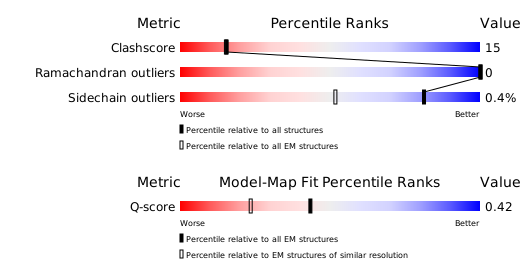
検証レポート(詳細版) をダウンロード
をダウンロード


