






 8YL4
8YL4
Crystal structure of the de novo designed protein 200 AA in the crystal form 1
8YL4 の概要
| エントリーDOI | 10.2210/pdb8yl4/pdb |
| 分子名称 | De novo protein, GLYCEROL (3 entities in total) |
| 機能のキーワード | de novo protein design, de novo protein |
| 由来する生物種 | Escherichia coli |
| タンパク質・核酸の鎖数 | 2 |
| 化学式量合計 | 47387.94 |
| 構造登録者 | |
| 主引用文献 | Frank, C.,Khoshouei, A.,Fu beta, L.,Schiwietz, D.,Putz, D.,Weber, L.,Zhao, Z.,Hattori, M.,Feng, S.,de Stigter, Y.,Ovchinnikov, S.,Dietz, H. Scalable protein design using optimization in a relaxed sequence space. Science, 386:439-445, 2024 Cited by PubMed Abstract: Machine learning (ML)-based design approaches have advanced the field of de novo protein design, with diffusion-based generative methods increasingly dominating protein design pipelines. Here, we report a "hallucination"-based protein design approach that functions in relaxed sequence space, enabling the efficient design of high-quality protein backbones over multiple scales and with broad scope of application without the need for any form of retraining. We experimentally produced and characterized more than 100 proteins. Three high-resolution crystal structures and two cryo-electron microscopy density maps of designed single-chain proteins comprising up to 1000 amino acids validate the accuracy of the method. Our pipeline can also be used to design synthetic protein-protein interactions, as validated experimentally by a set of protein heterodimers. Relaxed sequence optimization offers attractive performance with respect to designability, scope of applicability for different design problems, and scalability across protein sizes. PubMed: 39446959DOI: 10.1126/science.adq1741 主引用文献が同じPDBエントリー |
| 実験手法 | X-RAY DIFFRACTION (2.88 Å) |
構造検証レポート
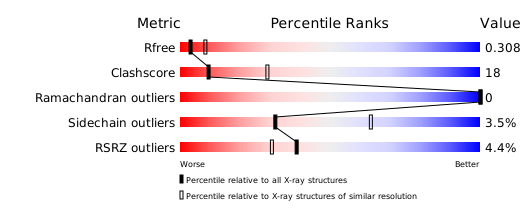
検証レポート(詳細版) をダウンロード
をダウンロード


