






8YC1
Acid phosphate hydrolase from Shigella flexneri (apo)
Summary for 8YC1
| Entry DOI | 10.2210/pdb8yc1/pdb |
| Descriptor | Acid phosphatase, GLYCEROL (2 entities in total) |
| Functional Keywords | apo, hydrolase |
| Biological source | Shigella flexneri |
| Total number of polymer chains | 3 |
| Total formula weight | 85426.81 |
| Authors | Du, W.Y.,Pan, X.M.,Dong, L.B. (deposition date: 2024-02-17, release date: 2025-02-19, Last modification date: 2025-11-26) |
| Primary citation | Du, W.,Cheng, Z.,Pan, X.,Liu, C.,Yue, M.,Li, T.,Xiao, Z.,Li, L.L.,Zeng, X.,Lin, X.,Li, F.,Dong, L.B. Microbe Engineering to Provide Drimane-Type Building Blocks for Chiral Pool Synthesis of Meroterpenoids. Angew.Chem.Int.Ed.Engl., 64:e202419463-e202419463, 2025 Cited by PubMed Abstract: Drimane-type merosesquiterpenoids (DMT) are a class of natural products with diverse structures and broad biological activity. Classical DMT synthesis relies on atom-inefficient plant-derived chiral pool building blocks, while alternative drimane-type building blocks such as drimenol and albicanol offer more direct routes but face production challenges. In this study, we engineered a microbial platform for efficient production of these building blocks. By optimizing the PhoN-IPK system through rational engineering and incorporating a Nudix hydrolase, we achieved a drimenol production of 398 mg/L and high albicanol titers of 1805 mg/L in shake flasks and 3.5 g/L in a bioreactor. Structural analysis and molecular dynamics simulations of the engineered PhoN provided insights into its improved catalytic efficiency. We demonstrated the utility of this platform by synthesizing several DMT using albicanol as the starting material, reducing the number of synthetic steps and improving overall efficiency as compared to classical approaches. PubMed: 39714334DOI: 10.1002/anie.202419463 PDB entries with the same primary citation |
| Experimental method | X-RAY DIFFRACTION (2.7 Å) |
Structure validation
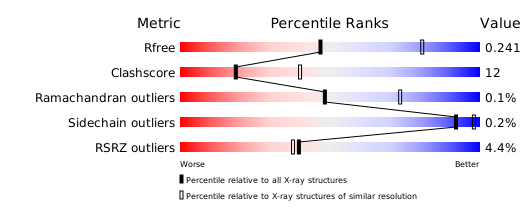
Download full validation report


