






Summary for 8VXI
| Entry DOI | 10.2210/pdb8vxi/pdb |
| Descriptor | CYP125MRCA, Beta-Sitosterol, PROTOPORPHYRIN IX CONTAINING FE, ... (4 entities in total) |
| Functional Keywords | p450, cytochrome, heme, sitosterol, phytosterols, cyp125, ancestor, lipid binding protein |
| Biological source | synthetic construct |
| Total number of polymer chains | 1 |
| Total formula weight | 49148.17 |
| Authors | |
| Primary citation | Doherty, D.Z.,De Voss, J.J.,Bruning, J.B.,Bell, S.G. Evolutionary insights into the selectivity of sterol oxidising cytochrome P450 enzymes based on ancestral sequence reconstruction. Chem Sci, 16:11110-11122, 2025 Cited by PubMed Abstract: The cytochrome P450 (CYP) enzyme CYP125A1 is a crucial enzyme for the long-term survival and pathogenicity of . CYP125 genes are found not only in pathogenic mycobacteria but are also widely dispersed within the Actinobacteria phylum, with many species possessing multiple copies of CYP125 encoding genes. Their primary function is the catalytic hydroxylation of the terminal methyl group of cholesterol and phytosterols. We have previously shown that CYP125 enzymes from distinct mycobacteria have substrate selectivity preferences for animal plant steroid oxidation. An evolutionary understanding of this selectivity is not known. Here, we use Ancestral Sequence Reconstruction (ASR), to support the hypothesis that some CYP125 enzymes evolved in a manner reflective of their adaptation to a pathogenic niche. We constructed a maximum-likelihood, most-recent common ancestor of the CYP125 clade (CYP125MRCA). We were then able to produce and characterise this enzyme both functionally and structurally. We found that CYP125MRCA was able to catalyse the terminal hydroxylation of cholesterol, phytosterols, and vitamin D (cholecalciferol); the latter was hydroxylated at both C-25 and C-26. This is the first example to date of vitamin D oxidation by a CYP125 enzyme, thereby demonstrating an increased substrate range of CYP125MRCA relative to its characterised extant relatives. The X-ray crystal structures of CYP125MRCA bound with sitosterol and vitamin D were determined, providing important insight into the changes that enable the expanded substrate range. PubMed: 40417289DOI: 10.1039/d5sc01863c PDB entries with the same primary citation |
| Experimental method | X-RAY DIFFRACTION (2.057 Å) |
Structure validation
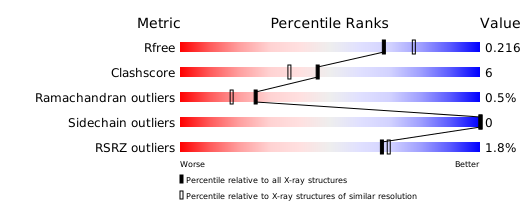
Download full validation report


