






 8VW3
8VW3
Structure of the non-symmetric capsomer of the Drosophila retrotransposon Copia capsid
8VW3 の概要
| エントリーDOI | 10.2210/pdb8vw3/pdb |
| 関連するPDBエントリー | 8VVW 8VVZ 8VWG |
| EMDBエントリー | 43571 43573 43575 43584 |
| 分子名称 | Copia VLP protein (1 entity in total) |
| 機能のキーワード | drosophila retrotransposon copia, virus like particle, gag protein |
| 由来する生物種 | Drosophila (fruit flies) |
| タンパク質・核酸の鎖数 | 6 |
| 化学式量合計 | 186893.94 |
| 構造登録者 | |
| 主引用文献 | M'Angale, P.G.,Lemieux, A.,Liu, Y.,Wang, S.,Zinter, M.,Alegre, G.,Simkin, A.,Budnik, V.,Kelch, B.A.,Thomson, T. Capsid transfer of the retrotransposon Copia controls structural synaptic plasticity in Drosophila. Plos Biol., 23:e3002983-e3002983, 2025 Cited by PubMed Abstract: Transposons are parasitic genome elements that can also serve as raw material for the evolution of new cellular functions. However, how retrotransposons are selected and domesticated by host organisms to modulate synaptic plasticity remains largely unknown. Here, we show that the Ty1 retrotransposon Copia forms virus-like capsids in vivo and transfers between cells. Copia is enriched at the Drosophila neuromuscular junction (NMJ) and transported across synapses, and disrupting its expression promotes both synapse development and structural synaptic plasticity. We show that proper synaptic plasticity is maintained in Drosophila by the balance of Copia and the Arc1 (activity-regulated cytoskeleton-associated protein) homolog. High-resolution cryogenic-electron microscopy imaging shows that the structure of the Copia capsid has a large capacity and pores like retroviruses but is distinct from domesticated capsids such as dArc1. Our results suggest a fully functional transposon mediates synaptic plasticity, possibly representing an early stage of domestication of a retrotransposon. PubMed: 39964983DOI: 10.1371/journal.pbio.3002983 主引用文献が同じPDBエントリー |
| 実験手法 | ELECTRON MICROSCOPY (3.47 Å) |
構造検証レポート
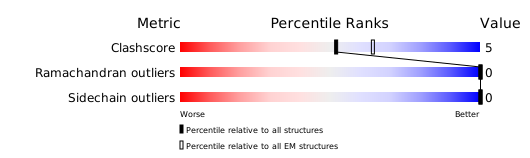
検証レポート(詳細版) をダウンロード
をダウンロード


