






 8VHS
8VHS
X-ray Structure of a De Novo Designed Self Assembled Peptide Tetramer Featuring a Cu(His)4(H2O) Coordination Motif
8VHS の概要
| エントリーDOI | 10.2210/pdb8vhs/pdb |
| 分子名称 | Cu-4SCC, COPPER (II) ION (3 entities in total) |
| 機能のキーワード | de novo design; peptides; self-assembly; copper, de novo protein |
| 由来する生物種 | synthetic construct |
| タンパク質・核酸の鎖数 | 4 |
| 化学式量合計 | 16118.36 |
| 構造登録者 | |
| 主引用文献 | Prakash, D.,Mitra, S.,Sony, S.,Murphy, M.,Andi, B.,Ashley, L.,Prasad, P.,Chakraborty, S. Controlling outer-sphere solvent reorganization energy to turn on or off the function of artificial metalloenzymes. Nat Commun, 16:3048-3048, 2025 Cited by PubMed Abstract: Metalloenzymes play essential roles in biology. However, unraveling how outer-sphere interactions can be predictably controlled to influence their functions remains a significant challenge. Inspired by Cu enzymes, we demonstrate how variations in the primary, secondary, and outer coordination-sphere interactions of de novo designed artificial copper proteins (ArCuPs) within trimeric (3SCC) and tetrameric (4SCC) self-assemblies-featuring a trigonal Cu(His) and a square pyramidal Cu(His)(OH) coordination-influence their catalytic and electron transfer properties. While 3SCC electrocatalyzes C-H oxidation, 4SCC does not. Cu-3SCC reacts more rapidly with HO than O, whereas 4SCC is less active. Electron transfer, reorganization energies, and extended HO-mediated hydrogen bonding patterns provide insights into the observed reactivity differences. The inactivity of 4SCC is attributed to a significant solvent reorganization energy barrier mediated by a specific His---Glu hydrogen bond. When this hydrogen bond is disrupted, the solvent reorganization energy is reduced, and C-H peroxidation activity is restored. PubMed: 40155633DOI: 10.1038/s41467-025-57904-5 主引用文献が同じPDBエントリー |
| 実験手法 | X-RAY DIFFRACTION (1.36 Å) |
構造検証レポート
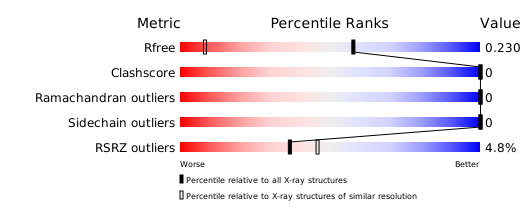
検証レポート(詳細版) をダウンロード
をダウンロード


