






 8UDA
8UDA
Crystal Structure of Mu class Glutathione-S-Transferase, TuGSTm12(Tetur05g05300) from Tetranychus urticae
8UDA の概要
| エントリーDOI | 10.2210/pdb8uda/pdb |
| 分子名称 | Glutathione-S-Transferase, ACETATE ION, Glutathione, ... (4 entities in total) |
| 機能のキーワード | glutathione-s-transferase, mu class gst, tetranychus urticae, tugstm12, transferase, transferase-substrate complex, transferase/substrate |
| 由来する生物種 | Tetranychus urticae (two-spotted spider mite) |
| タンパク質・核酸の鎖数 | 2 |
| 化学式量合計 | 52977.36 |
| 構造登録者 | |
| 主引用文献 | Arriaza, R.H.,Khatri, K.,Abiskaroon, B.,O'Malley, A.,Chouhan, V.,Godziashvili, D.,Camini, A.M.,Walshe-Roussel, B.,Zhurov, V.,Rebros, M.,Grbic, M.,Grbic, V.,Saraiva Macedo Timmers, L.F.,Chruszcz, M. Investigation of Molecular and Structural Properties of Two Mu-class GSTs From Tetranychus urticae. J.Mol.Biol., 438:169742-169742, 2026 Cited by PubMed Abstract: Tetranychus urticae (T. urticae), commonly known as two spotted spider mites (TSSM), is a major agricultural pest worldwide that feeds on all major crops and has developed resistance to most chemical compounds used for its control. Genome sequence analysis of T. urticae revealed an expansion in gene families that play a role in digestion, detoxification, and transport of xenobiotics. This large detoxifying machinery, when paired with high transcriptional plasticity, has been linked to the unprecedented xenobiotic responsiveness of this pest. To better understand how T. urticae has evolved the extensive enzymes for xenobiotic detoxification, two closely related T. urticae Mu-class GSTs, TuGSTm06 (Tetur05g05220) and TuGSTm12 (Tetur05g05300), were structurally and functionally characterized. Enzymatic characterization of these two recombinant enzymes demonstrated different activity towards model substrates 1-chloro-2,4,-dinitrobenzene (CDNB) and isothiocyanates (ITCs). Some ITCs that we used in the studies are generated by plants and serve as defense compounds. We determined the crystal structures of TuGSTm06 and TuGSTm12 which revealed that the active sites of these enzymes differed only in three residues in the H-site. Single amino acid substitution suggested that these differences in the catalytic pocket may contribute to the specific catalytic attributes of each enzyme. Additionally, complementary molecular dynamics simulations predicted differences in the overall dynamic behavior of TuGSTm06 and TuGSTm12 and a correlation between the active site residues and protein dynamics in distant residues was determined. Our work highlights the complexity of the molecular basis underlying the activity of Mu-class TuGSTs and suggests that they may play a role in overcoming plant defenses using ITCs. Elucidating these molecular details is an essential step towards finding effective ways to manage this pest. PubMed: 41802457DOI: 10.1016/j.jmb.2026.169742 主引用文献が同じPDBエントリー |
| 実験手法 | X-RAY DIFFRACTION (2.8 Å) |
構造検証レポート
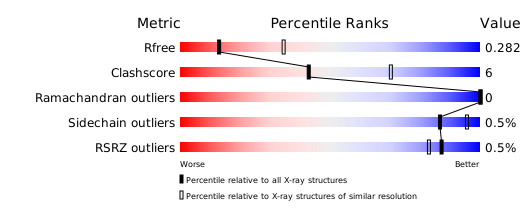
検証レポート(詳細版) をダウンロード
をダウンロード


