






8TN5
The Crystal Structure of a human monoclonal antibody (aAb), termed TG10, complexed with a GlcNH2
Summary for 8TN5
| Entry DOI | 10.2210/pdb8tn5/pdb |
| Descriptor | TG10, Heavy chain, TG10, Light chain, SULFATE ION, ... (6 entities in total) |
| Functional Keywords | monoclonal antibody, tg10, glcnac, immune system |
| Biological source | Homo sapiens (human) More |
| Total number of polymer chains | 2 |
| Total formula weight | 48066.43 |
| Authors | Li, M.,Wlodawer, A.,Temme, S.,Gildersleeve, J. (deposition date: 2023-08-01, release date: 2024-12-04, Last modification date: 2025-06-18) |
| Primary citation | Temme, J.S.,Tan, Z.,Li, M.,Yang, M.,Wlodawer, A.,Huang, X.,Schneekloth Jr., J.S.,Gildersleeve, J.C. Insights into biofilm architecture and maturation enable improved clinical strategies for exopolysaccharide-targeting therapeutics. Cell Chem Biol, 31:2096-2111.e7, 2024 Cited by PubMed Abstract: Polysaccharide intercellular adhesin (PIA), an exopolysaccharide composed of poly-N-acetyl glucosamine (PNAG), is an essential component in many pathogenic biofilms. Partial deacetylation of PNAG is required for biofilm formation, but limited structural knowledge hinders therapeutic development. Employing a new monoclonal antibody (TG10) that selectively binds highly deacetylated PNAG and an antibody (F598) in clinical trials that binds highly acetylated PNAG, we demonstrate that PIA within the biofilm contains distinct regions of highly acetylated and deacetylated exopolysaccharide, contrary to the previous model invoking stochastic deacetylation throughout the biofilm. This discovery led us to hypothesize that targeting both forms of PNAG would enhance efficacy. Remarkably, TG10 and F598 synergistically increased in vitro and in vivo activity, providing 90% survival in a lethal Staphylococcus aureus challenge murine model. Our advanced model deepens the conceptual understanding of PIA architecture and maturation and reveals improved design strategies for PIA-targeting therapeutics, vaccines, and diagnostic agents. PubMed: 39637855DOI: 10.1016/j.chembiol.2024.11.005 PDB entries with the same primary citation |
| Experimental method | X-RAY DIFFRACTION (1.76 Å) |
Structure validation
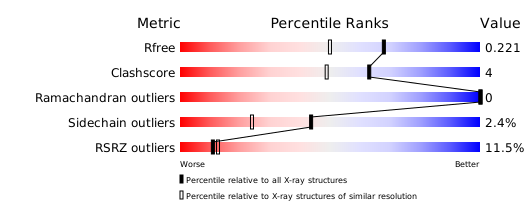
Download full validation report


