






 8S81
8S81
VirC mutant C114A-Q334A-R335A-R338A
8S81 の概要
| エントリーDOI | 10.2210/pdb8s81/pdb |
| 分子名称 | HMG-CoA synthase-like protein, 1,2-ETHANEDIOL (3 entities in total) |
| 機能のキーワード | 3-hydroxy-3-methylglutaryl-coa synthase, conformational flexibility, substrate specificity, transferase |
| 由来する生物種 | Streptomyces virginiae |
| タンパク質・核酸の鎖数 | 2 |
| 化学式量合計 | 92789.53 |
| 構造登録者 | |
| 主引用文献 | Collin, S.,Weissman, K.J.,Gruez, A. Structural Plasticity within 3-Hydroxy-3-Methylglutaryl Synthases Catalyzing the First Step of beta-Branching in Polyketide Biosynthesis Underpins a Dynamic Mechanism of Substrate Accommodation. Jacs Au, 4:3833-3847, 2024 Cited by PubMed Abstract: Understanding how enzymes have been repurposed by evolution to carry out new functions is a key goal of mechanistic enzymology. In this study we aimed to identify the adaptations required to allow the 3-hydroxy-3-methylglutaryl (HMG)-CoA synthase (HMGCS) enzymes of primary isoprenoid assembly to function in specialized polyketide biosynthetic pathways, where they initiate β-branching. This role notably necessitates that the HMG synthases (HMGSs) act on substrates tethered to noncatalytic acyl carrier protein (ACP) domains instead of coenzyme A, and accommodation of substantially larger chains within the active sites. Here, we show using a combination of X-ray crystallography and small-angle X-ray scattering, that a model HMGS from the virginiamycin system exhibits markedly increased flexibility relative to its characterized HMGCS counterparts. This mobility encompasses multiple secondary structural elements that define the dimensions and chemical nature of the active site, as well the catalytic residues themselves. This result was unexpected given the well-ordered character of the HMGS within the context of an HMGS/ACP complex, but analysis by synchrotron radiation circular dichroism demonstrates that this interaction leads to increased HMGS folding. This flexible to more rigid transition is notably not accounted for by AlphaFold2, which yielded a structural model incompatible with binding of the native substrates. Taken together, these results illustrate the continued necessity of an integrative structural biology approach combining crystallographic and solution-phase data for elucidating the mechanisms underlying enzyme remodeling, information which can inform strategies to replicate such evolution effectively in the laboratory. PubMed: 39483223DOI: 10.1021/jacsau.4c00477 主引用文献が同じPDBエントリー |
| 実験手法 | X-RAY DIFFRACTION (1.99 Å) |
構造検証レポート
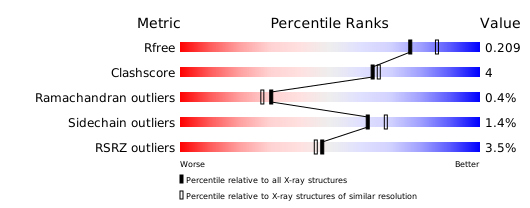
検証レポート(詳細版) をダウンロード
をダウンロード


