






 8RWF
8RWF
Domains 1 and 2 of Bacillus anthracis Sap S-layer in complex with Nb692
8RWF の概要
| エントリーDOI | 10.2210/pdb8rwf/pdb |
| 分子名称 | S-layer protein sap, Sap binding Nanobody 692 (3 entities in total) |
| 機能のキーワード | s-layer, nanobody, anthrax, structural protein |
| 由来する生物種 | Bacillus anthracis 詳細 |
| タンパク質・核酸の鎖数 | 6 |
| 化学式量合計 | 98365.54 |
| 構造登録者 | |
| 主引用文献 | Cecil, A.J.,Sogues, A.,Gurumurthi, M.,Lane, K.S.,Remaut, H.,Pak, A.J. Molecular dynamics and machine learning stratify motion-dependent activity profiles of S-layer destabilizing nanobodies. Pnas Nexus, 3:pgae538-pgae538, 2024 Cited by PubMed Abstract: Nanobody (Nb)-induced disassembly of surface array protein (Sap) S-layers, a two-dimensional paracrystalline protein lattice from , has been presented as a therapeutic intervention for lethal anthrax infections. However, only a subset of existing Nbs with affinity to Sap exhibit depolymerization activity, suggesting that affinity and epitope recognition are not enough to explain inhibitory activity. In this study, we performed all-atom molecular dynamics simulations of each Nb bound to the Sap binding site and trained a collection of machine learning classifiers to predict whether each Nb induces depolymerization. We used feature importance analysis to filter out unnecessary features and engineered remaining features to regularize the feature landscape and encourage learning of the depolymerization mechanism. We find that, while not enforced in training, a gradient-boosting decision tree is able to reproduce the experimental activities of inhibitory Nbs while maintaining high classification accuracy, whereas neural networks were only able to discriminate between classes. Further feature analysis revealed that inhibitory Nbs restrain Sap motions toward an inhibitory conformational state described by domain-domain clamping and induced twisting of domains normal to the lattice plane. We believe these motions drive Sap lattice depolymerization and can be used as design targets for improved Sap-inhibitory Nbs. Finally, we expect our method of study to apply to S-layers that serve as virulence factors in other pathogens, paving the way forward for Nb therapeutics that target depolymerization mechanisms. PubMed: 39660065DOI: 10.1093/pnasnexus/pgae538 主引用文献が同じPDBエントリー |
| 実験手法 | X-RAY DIFFRACTION (3.11 Å) |
構造検証レポート
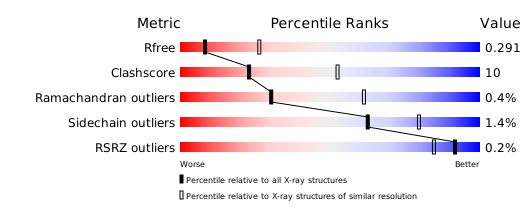
検証レポート(詳細版) をダウンロード
をダウンロード


