






 8R4K
8R4K
Plastidial phosphorylase Pho1 trimer from Solanum tuberosum
8R4K の概要
| エントリーDOI | 10.2210/pdb8r4k/pdb |
| 分子名称 | Alpha-1,4 glucan phosphorylase L-1 isozyme, chloroplastic/amyloplastic, GLYCEROL (3 entities in total) |
| 機能のキーワード | plastidial phosphorylase, carbohydrate metabolism, transferase |
| 由来する生物種 | Solanum tuberosum (potato) |
| タンパク質・核酸の鎖数 | 3 |
| 化学式量合計 | 312117.38 |
| 構造登録者 | |
| 主引用文献 | Koulas, S.M.,Kyriakis, E.,Tsagkarakou, A.S.,Leonidas, D.D. Kinetic and Structural Studies of the Plastidial Solanum tuberosum Phosphorylase. Acs Omega, 9:41841-41854, 2024 Cited by PubMed Abstract: Kinetics and structural studies of the plastidial phosphorylase (Pho1) revealed that the most active form of the enzyme (Pho1ΔL78) is composed by two segments generated by proteolytic degradation of an approximately 65-residue-long peptide (L78) approximately in the middle of the Pho1 primary structure. Pho1ΔL78 is 1.5 times more active than the nonproteolyzed enzyme in solution and shows stronger specificity for glycogen, α-d-glucose, caffeine, and β-cyclodextrin than Pho1. The crystal structure of Pho1ΔL78 has been resolved at 2.2 Å resolution and revealed similarities and differences with the mammalian enzymes. The structural fold is conserved as is the active site, while other binding sites such as the inhibitor, the glycogen storage, the quercetin, and the allosteric are not. The binding of α-d-glucose, caffeine, and β-cyclodextrin to Pho1 has been studied by X-ray crystallography and revealed significant differences from those of the mammalian phosphorylases. As Pho1 is capable of catalyzing both starch synthesis and degradation, our studies suggest that the direction of Pho1 activity is regulated by the proteolytic degradation of the L78 peptide. PubMed: 39398113DOI: 10.1021/acsomega.4c06313 主引用文献が同じPDBエントリー |
| 実験手法 | X-RAY DIFFRACTION (3.3 Å) |
構造検証レポート
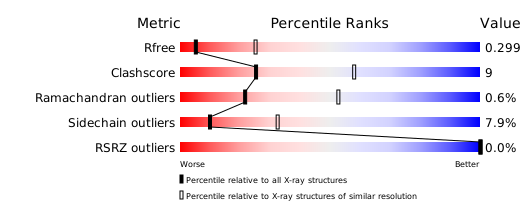
検証レポート(詳細版) をダウンロード
をダウンロード


